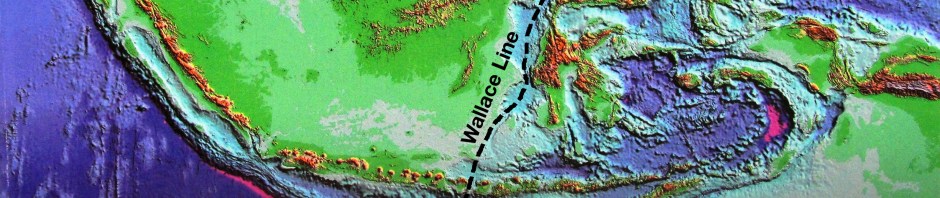
In 1856, Alfred Russel Wallace sailed from Singapore to Bali and then to Lombok. He wrote in his book ‘The Malay Archipelago’:
During the few days which I stayed on the north coast of Bali, on my way to Lombok, I saw several birds highly characteristic of Javanese ornithology … On crossing over to Lombok, seperated from Bali by a Strait less than twenty miles wide, I naturally expected to meet with these same birds again; but during a stay of three months, I never saw one of them, but found a totally different species, most of which were entirely unknown not only in Java, but also in Borneo, Sumatra and Malacca. For example the commonest birds in Lombok were white cockatoos and honeysuckers, belonging to family groups which are entirely absent from the western region of the Archipelago.
The Lombok Strait represents the boundary between the fauna of Asia and that of Australia, a boundary which Thomas Huxley later named the Wallace Line. We only have to look at a seafloor map to realise that this line represents the edge of the Asian continental shelf.

As the Australian/Papuan tectonic plate moved north it collided with the Pacific Plate which is moving west. As a consequence the Indonesian island arc was turned back upon itself and large chunks of Australia were sliced off and inserted into Eastern Indonesia including the eastern part of Sulawesi.
By his observations of the relationship between zoology and geography, Alfred Russel Wallace had founded the science of biogeography. As he describes these two divisions of the earth as differing in animal life as Europe does from America. Also, before there were concepts of Continental Drift or Plate Tectonics, he had decided that Australia had collided with Asia.
Ian Burnet has updated his 2017 book ‘Where Australia Collides with Asia’ in a new edition, now titled ‘The Wallace Line’.
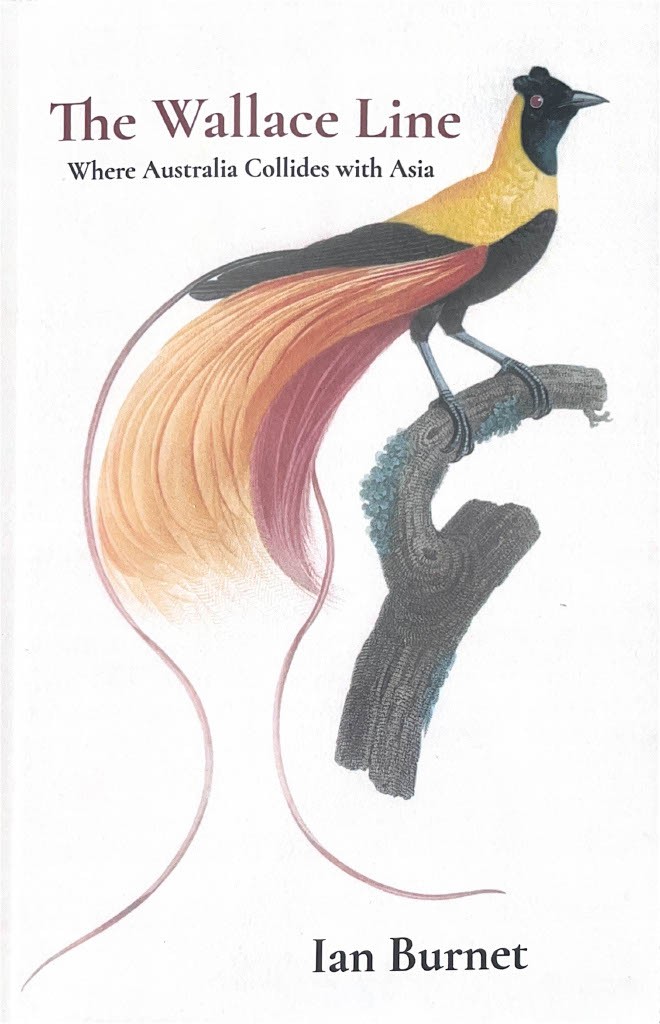
The ‘Wallace Line’ is now available as a paperback or an ebook, on order from your favourite bookstore or the usual online retailers.


 spiceislandsblog