The Ombak Putih – A traditional yet modern Bugis Pinisi

The Ombak Putih

The Ombak Putih

The Bugis Pinisi is in part a copy of a western schooner of the mid-nineteenth century and the word pinisi is thought to have come from the english word pinnace. They are recognized by their tall ketch-rig of seven sails including two tops sails and three jibs, with a bipod or tripod mast and fixed gaffs. Most have a long raking bow and bowsprit. The other characteristic is the two lateral rudders which are supported on heavy beams which run right through the stern.

I first saw the Ombak Putih when anchored off Sumbawa in another vessel. When the Ombak Putih with her sleek white hull and large blue sails came into view and anchored nearby -it was ‘love at first sight’.
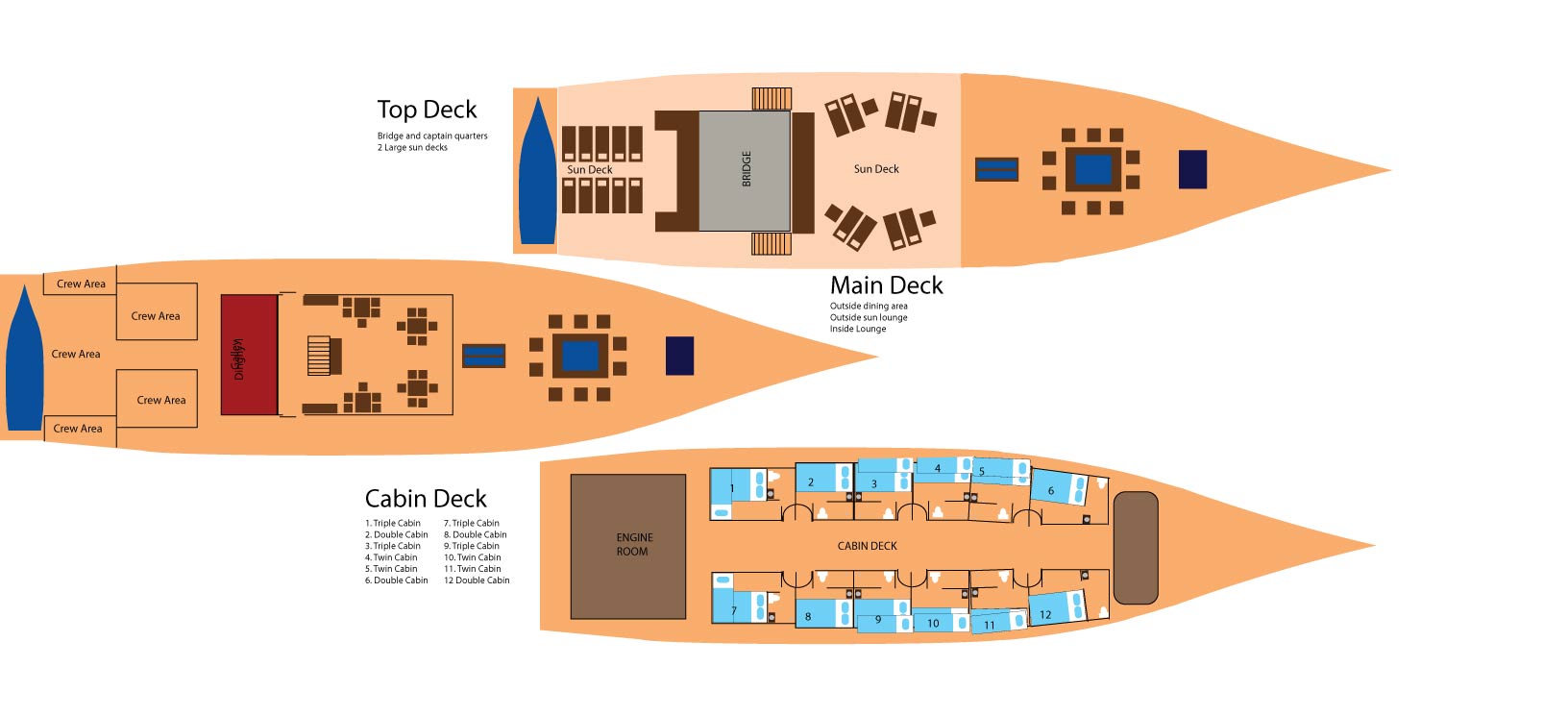
OmbakPutih_Deck-plan-2

The Ombak Putih is a mix of traditional and modern ‘pinisi’ design. Her hull and rigging are traditional, while the deckhouse and interior are custom-designed to fulfil the need for a spacious, open and comfortable vessel. An important design principle was the need for a boat, which would provide ample room for both 24 guests plus crew, with each cabin air conditioned and with an ensuite bathroom. The design therefore incorporated a large deckhouse that was low enough to maintain the original sail plan, while also providing sufficient sleeping and living quarters for the crew and a spacious lounge and kitchen for the guests. Behind the bridge on top of the deckhouse, the design incorporated a large sundeck with a canopy to provide shade.
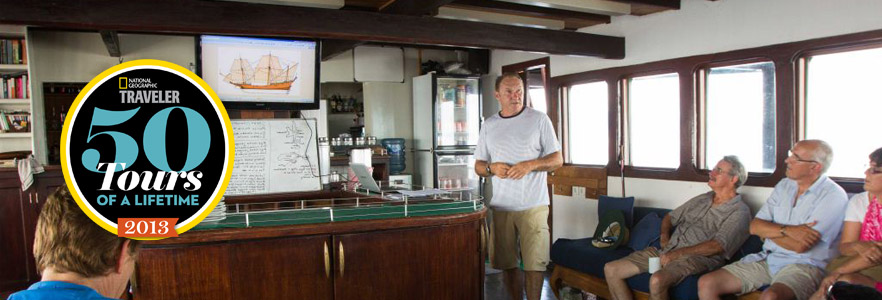
The spacious lounge area

The spacious lounge area

The Ombak Putih was built alongside a muddy river in Batulicin, Kalimantan. On a deserted piece of land, the keel was laid on 11 May 1996. Finding suitable timber for the keel was not easy as ideally it should consist of only one piece. The Ombak Putih’s keel measures 23m by 40cm by 40cm.

Construction then started with the adding of the bow and the stern pieces of the keel. The position and length of the keel, stern and stem will always determine the shape of the hull. The shipbuilders’ technique was to place the first skin planks from the keel upwards. No moulds were erected before the skin planking reached at least 1.5m above the keel.The Buginese boatbuilders are renowned for their skills but it’s still amazing that this huge structure (36m in length, with a beam of 10m and a draft of 4.5m) was made without any drawings, fully relying on the craftsmanship of its builders. A Dutch naval architect was hired to design the interior and the deckhouse and to recalculate all of the dimensions.

On 27 May 1997, the Ombak Putih was launched. Buginese tradition demands that a goat is ritually sacrificed and its blood scattered over various important parts of the ship. In June, the owners received the official ownership documentation, and the crew then navigated the boat to Surabaya where suppliers were already waiting to install air-conditioners, electrical cables and bathroom fittings etc.

In Tanjung Perak, the old canal-type harbour of Surabaya, the boat finally began to look like a real sailing vessel. The top masts were positioned with the help of a huge crane, and the hull was painted white, initially with just two coats of paint although it would take ten coats before the boat really looked white. On 9 August 1997, the beautiful Ombak Putih triumphantly set off on her maiden voyage to Bali.
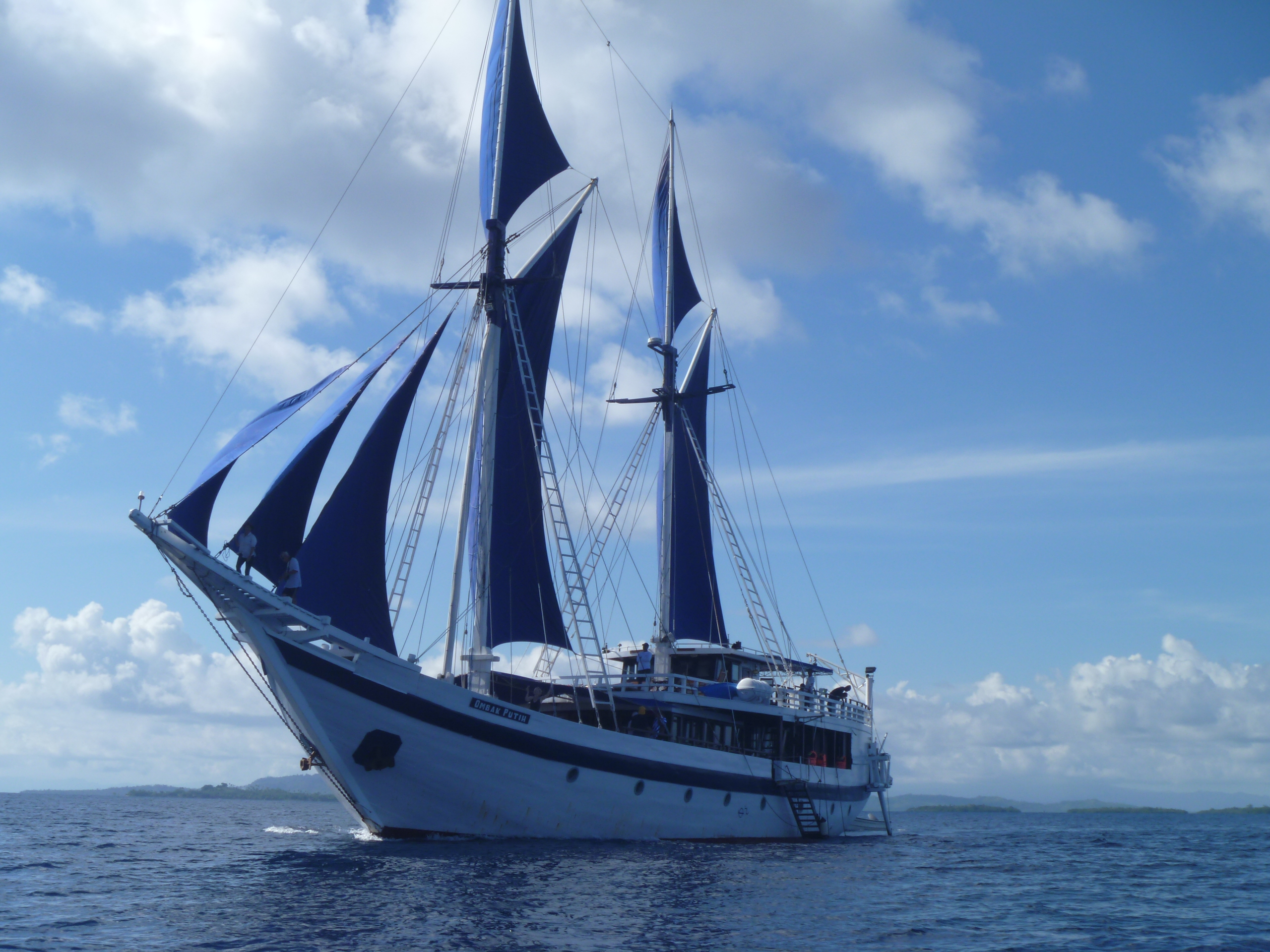
Ombak Puith with sails 2

The Ombak Putih sails with Ian Burnet on its ‘East Indies Spice Exploration’ voyage around the Eastern Indonesian Archipelago from September 26 to October 7, departing from Maumere in Flores. For more information and bookings contact Sea Trek Sailing Adventures at http://www.seatrekbali.com
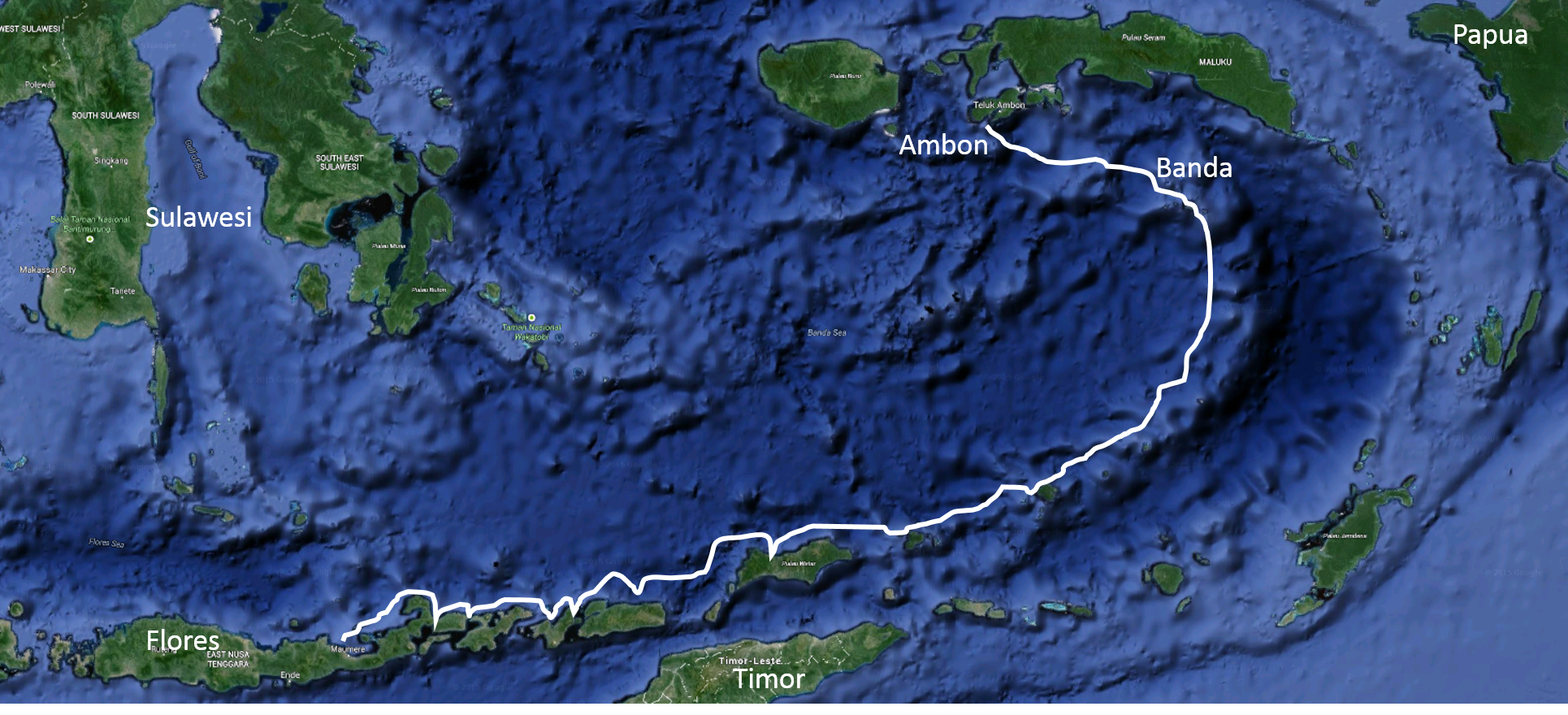
Maumere to Ambon
Maumere to Ambon

Posted in Uncategorized | Tagged , , , | 2 Comments

Treasure Ships – Art in the Age of Spices – Part 1

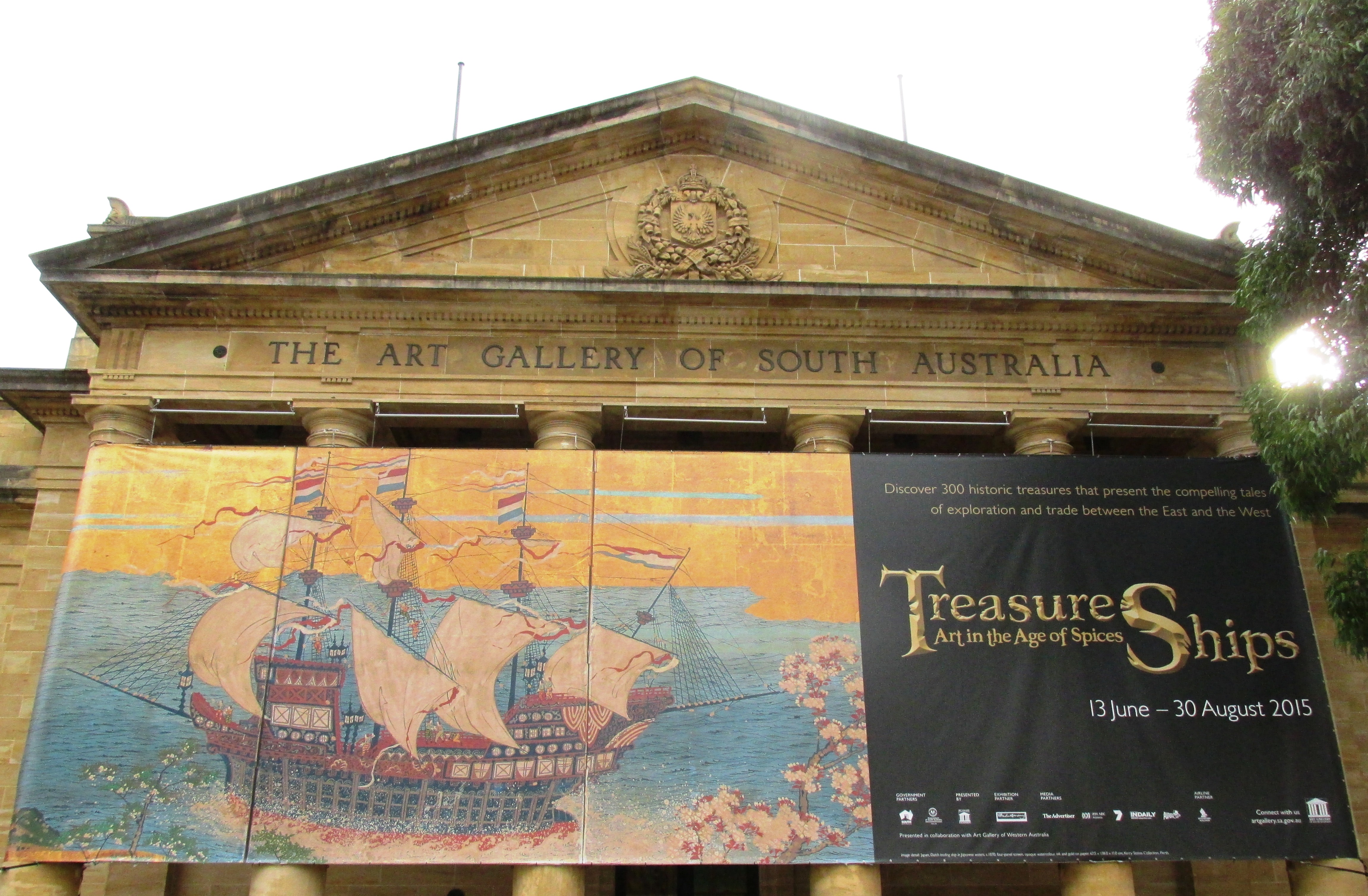
This exhibition at the Art Gallery of South Australia includes 300 outstanding and rarely-seen works of ceramics, decorative arts, furniture, metalware, paintings, prints, and textiles from public and private collections around the world.
The selected works of art reveal how the international trade in spices and other exotic commodities inspired dialogue between Asian and European artisits, centuries-old conversations whose heritage is the aesthetic globalism we know today.

IMG_0998 - Copy

The map by Petrus Plancius is a masterpiece of cartographic art, the sharpness of the image shows that it was one of the first maps to be engraved on copper plate. On the base of the map are the spices, the nutmeg and cloves that the Portuguese, Dutch and English were seeking and the map served as a prospectus for the raising of funds for the first Dutch expedition to the East Indies in 1595 by ‘The Company for Far Distant Lands’ which was a forerunner to the Dutch East India Company (VOC).

IMG_0995 - Copy

After Vasco da Gama rounded the Cape of Good Hope in 1497 the Portuguese came to the East ‘In search of Christian and Spices’. Their superior ships and weapons allowed them to establish trading bases in Goa, Malacca, Ternate, Banda, Macao and Nagasaki and extend their trading network across Asia.They were followed almost hundred years later by the Dutch and the English in 1595 and 1601 respectively.

IMG_0936

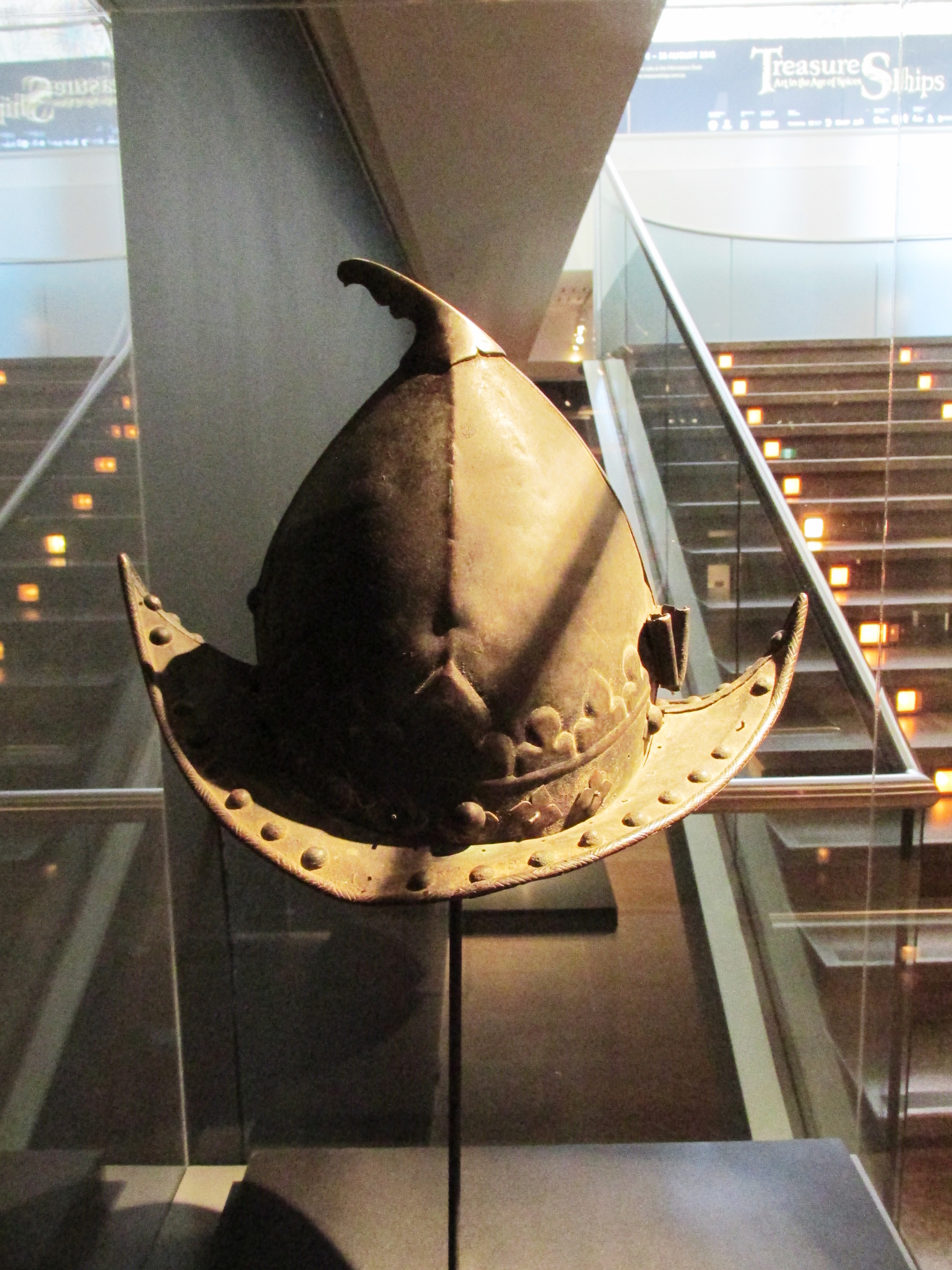
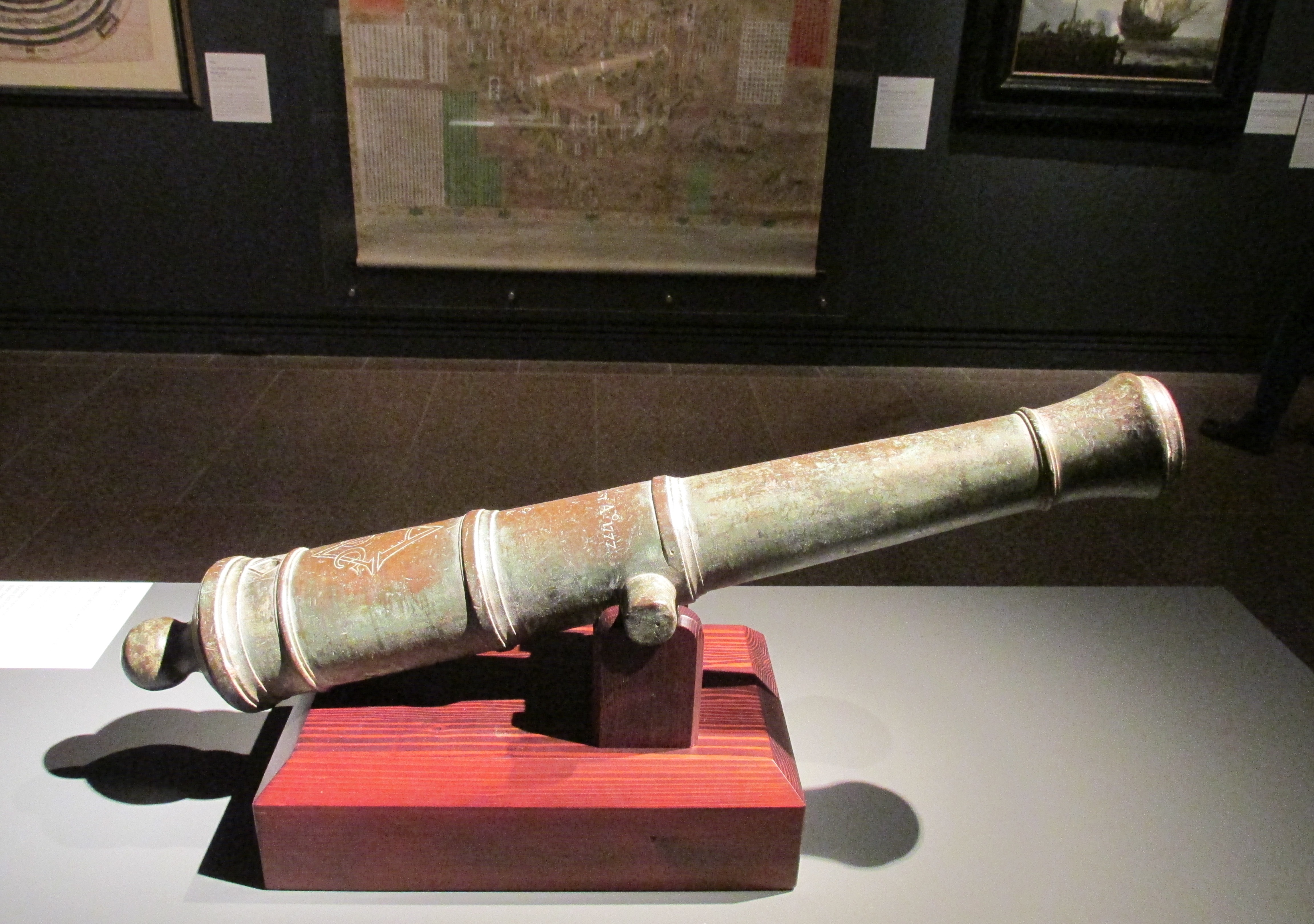
At the entrance to the exhibit are examples of the weapons and armour that the Europeans used to establish their trading bases across the Eastern Seas. A Portuguese helmet and a Dutch cannon are on display

IMG_1067

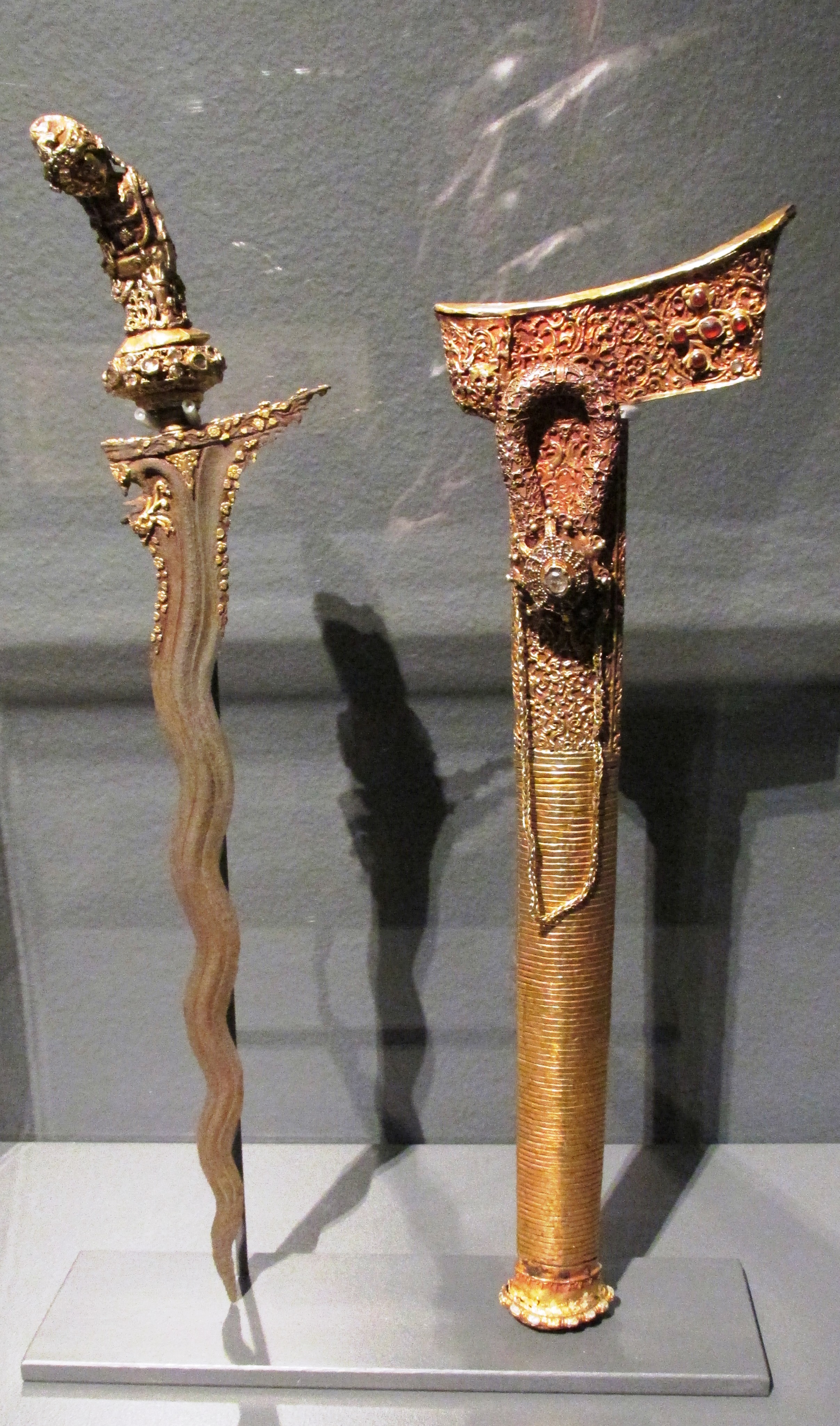
This is a kris made for a Sultan, its blade is inlaid with gold and its sheath decorated with diamonds and semi-precious stones and although purely decorative it represents the weapons used by the islanders to fight the Portuguese and the Dutch intruders.

IMG_0944 - Copy

The Portuguese captured the island of Goa on the west coast of India and used it as the base for their Estado do India and their expanding trade routes across the East Indies and the Orient. This map shows the development of the city Goa in 1699.

06_Plan of the City of Goa,1750

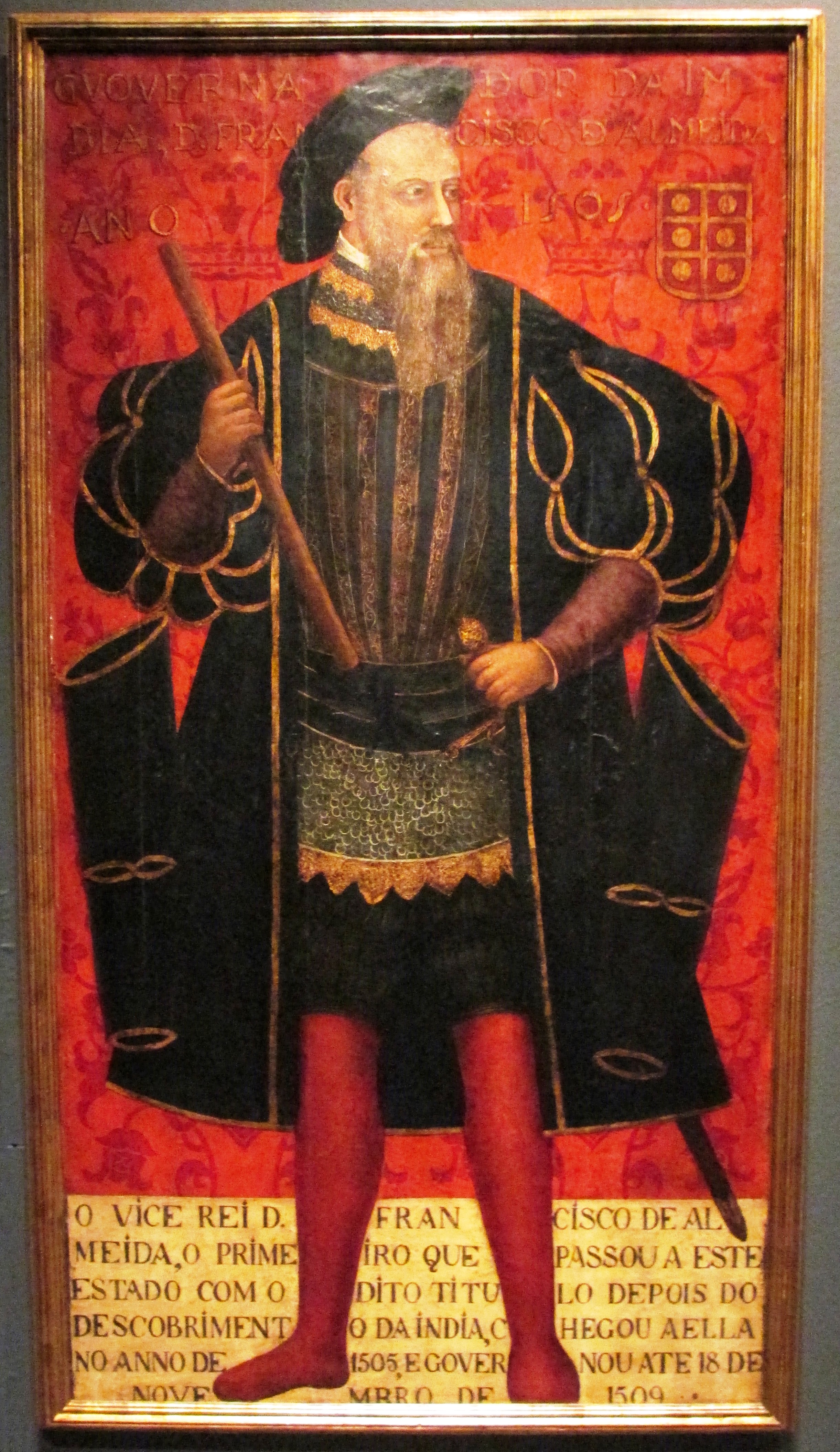
Francisco de Almeida became the first Governor of Goa and the Estado da India

IMG_0940

This large wooden chest with a VOC insignia on its front was probably used by VOC personnel to bring their possessions by ship to the East Indies or to be filled with silver dollars to purchase spices and other trade items in the archipelago.

IMG_1066 - Copy

Spanish silver dollars were the common trade currency but these are German silver thaler coins dated 1592 to 1624 and were recovered from the wreck of the Batavia which sank in 1629 off the coast of Western Australia.

IMG_1105

http://www.ianburnetbooks.com

← Back

Thank you for your response. ✨


Posted in Uncategorized | Tagged , , , , , , , , , , , , | 2 Comments

Terra Australis 1606

Terra Australis 1606 – The voyages of Willem Janszoon and Luis Vas de Torres and the first European discovery of Australia

This talk was presented at the SMSA and will be broadcast by ABC Radio National on their ‘Big Ideas’ program. The maps and a brief text are presented here for the benefit of listeners to that program.

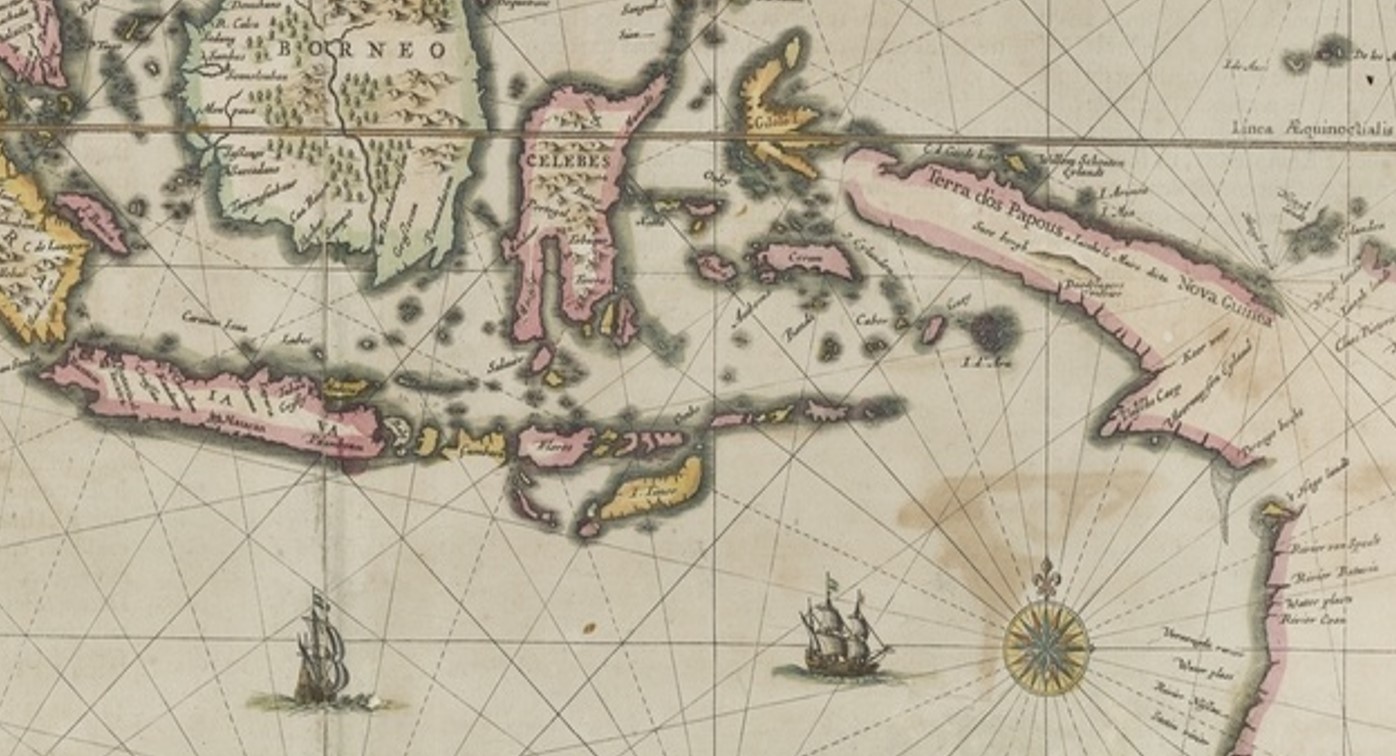
Hendrick Hondius 1641

Hendrick Hondius 1641

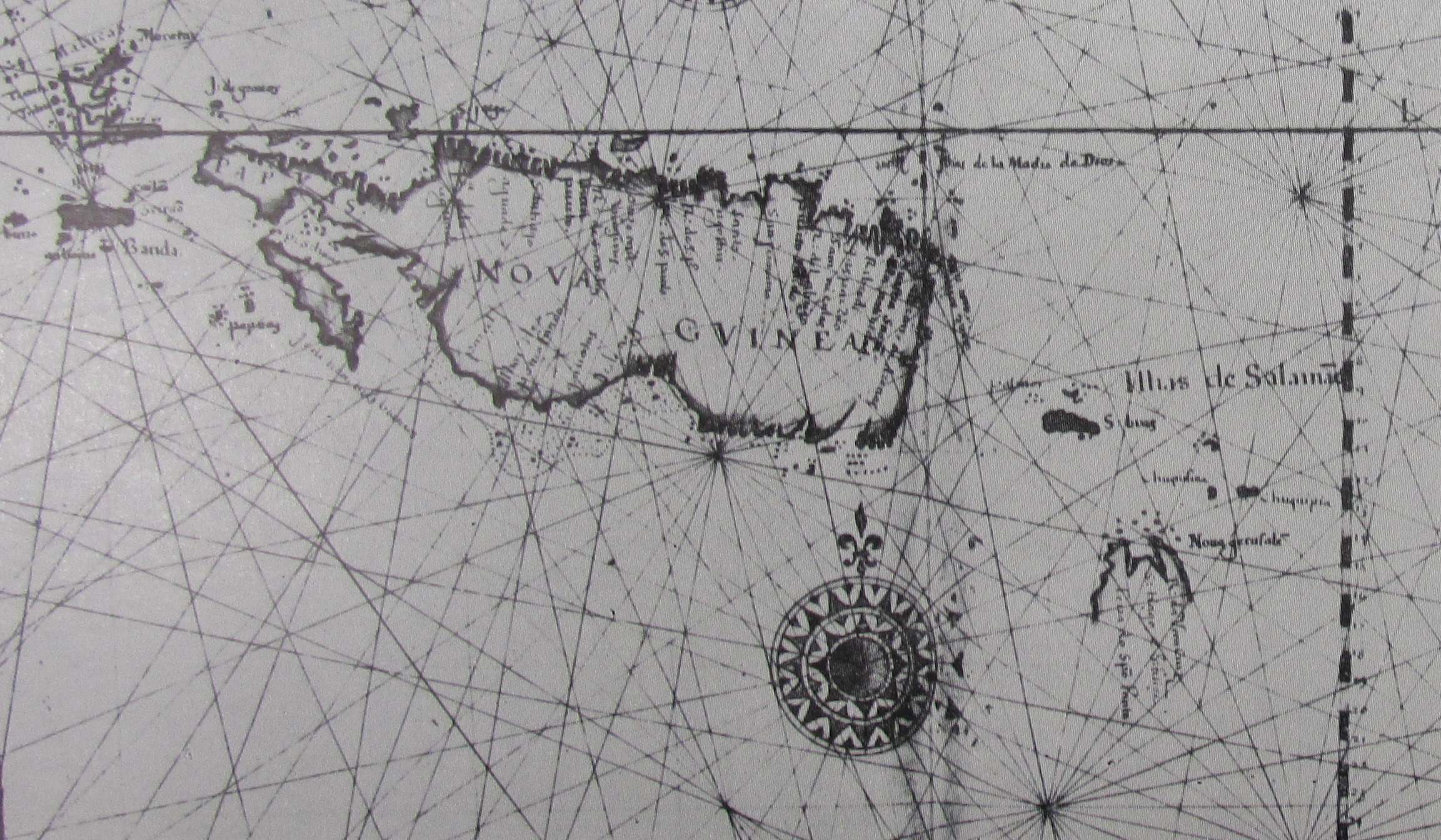
In 1528, the Spaniard Alvaro de Saavedra commanding the Santiago attempted to sail from the Spice Islands of Eastern Indonesia back across the Pacific and charted the north coast of New Guinea which he named Isola Del Oro (Island of Gold). To be renamed Nueva Guinea by another Spaniard, Inigo Ortez de Retez in 1545.

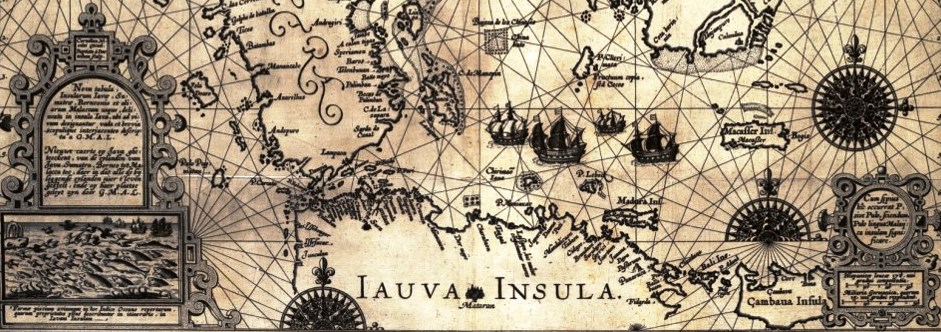
Petrus Plancius 1594

Petrus Plancius 1594

In 1595 the yacht Duyfken (Little Dove) sailed with the first Dutch expedition to the East Indies which was funded by ‘The Company for Far Distant Lands’ a precursor to the United Dutch East India Company (VOC). The fleet reached Banten near the Sunda Straits and began trading for spices, this map shows the fleet in the Java Sea and the Duyfken is the smaller of the vessels.

Willem Lodewijcksz 1595

Willem Lodewijcksz 1595

Willem Janszoon in the Duyfken

After the first VOC war fleet captured the Portuguese forts in Ambon,Banda and Ternate in 1605 the Duyfken commanded by Willem Janszoon departed Banten and then Banda for a voyage of discovery along the south coast of New Guinea. Captain John Saris of the English East India Company in Banten reported:

The eighteenth (November 1605) here departed a small pinnasse of the Flemings, for the discovery of the island called Nova Ginnea, which, as it is said, affordeth great store of Gold.

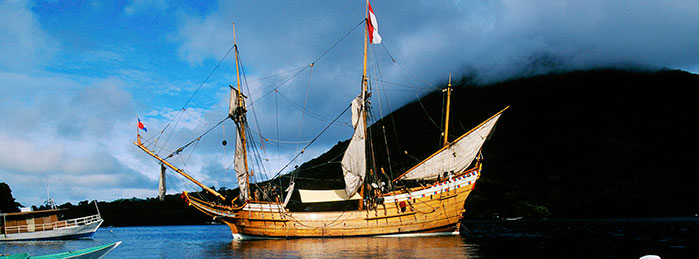
The replica Duyfken in Banda

The replica Duyfken in Banda

The ships log and maps of the 1606 Duyfken voyage have never been found in the VOC archives. But it was while examining the volumes of a Blaeu Atlas originally belonging to Prince Eugene of Savoy, first in 1920 and again in 1931 at the Hofbibliothek in Vienna, that Dr F.C.Wieder found it also contained the “Secret Atlas of the East-India Company “–copies of original maps no longer in the company’s archives–including the charts of the voyages of the Duyfken to New Guinea and Australia in 1606, and also of the Arnhem, which accompanied the Pera in 1623.

The voyage of the Duyfken 1606 from the 'Secret Atlas of the VOC'

The voyage of the Duyfken 1606 from the ‘Secret Atlas of the VOC’

In March 1606 the Duyfken reached what is now Cape York and made the first European encounter with the Australian Aborigines, then returning via the south coast of New Guinea where some of the crew were killed in an encounter with the Papuans.

Detail of the west coast of Cape York from the 'Secret Atlas of the VOC'

Detail of the west coast of Cape York from the ‘Secret Atlas of the VOC’

The Duyfken returned to Banda,then Banten, and Captain John Saris of the English East India Company again reported:

The fifteenth of June (1607) here arrived Nockhoda Tingall a Cling man from Banda in a Java Junke, laden with mace and nutmegs …
He told me that the Flemmings Pinnasse, which went upon the discovery for Nova Ginny, was returned to Banda, having found the island: but in sending their men on shoare to intreate of trade, there were nine of them killed by the heathens, which are man-eaters: so they were constrained to return, finding no good to be done there

Luis Vas de Torres in the San Pedrico

In 1606 Pedro Ferdinandes de Queirós led a Spanish expedition across the Pacific to discover the ‘Great South Land’. They reached Vanuatu and named it Tierra Australis de Espiritu Santo. On the night of 11 June 1606, Queirós in the San Pedro y San Pablo became separated from the two other ships of his fleet in bad weather and then sailed to Acapulco in Mexico. Luis Vaz de Torres with the galleon San Pedrico and the tender Los Tres Reyes sailed south east looking for the Great South Land, before turning north to sail to Manila. Unable make the north coast of New Guinea due to the prevailing winds, they turned east to follow the south coast of New Guinea.

William Dalrymple 1764 Showing the Torres voyage

William Dalrymple 1764
Showing the Torres voyage

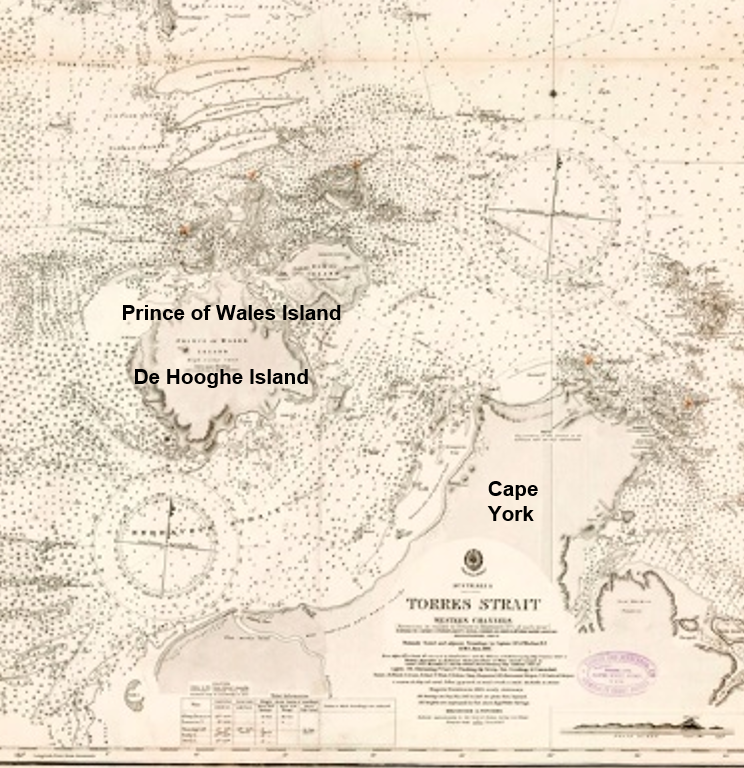
Again the ships logs and maps of the Torres voyage are missing but details have been reconstructed from a letter by Torres from Manila in 1607 and by a report by the second in command, Diego Prado y Tovar after he returned to Spain in 1615. The San Pedrico finally cleared the Torres Strait between the Dutch named De Hooghe Island (High Island) and Cape York and as descibed by Prado:

We were amongst reefs and shoals for 34 days’… there were many large islands and they appeared more on the southern side

Endevour Strait

After clearing the Torres Strait the Spanish ships sailed for the Spice Islands where Torres left 20 men and the tender Los Tres Reyes to reinforce the Spanish fort on Ternate before continuing to Manila.
A credible outline of New Guinea appears on a World Map by the Portuguese cartographer Godinho de Eredia in 1613, since we know that Prado returned to Spain via Goa then he could have given details of his voyage with Torres to Eredia who was based in Goa or Malacca.

World map Godinho Eredia 1613

World map Godinho Eredia 1613

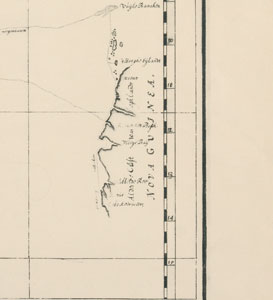
A detailed map of New Guinea was discovered in the ‘Dutchess du Berry Atlas’ dated around 1628 and it must have come from the Torres voyage. Torres and Prado were apparently unaware of the significance of the larger island they describe to the south as any indication of this island or Australia does not appear on the map.

Map of New Guinea from the 'Duchess du Berry Atlas' 1628?

Map of New Guinea from the ‘Duchess du Berry Atlas’ 1628?

The first image of Australia on a world map appears on the map ‘Mar del Sur’ of the Pacific Ocean by the VOC mapmaker Hessel Gerritz in 1622 and is obviously the most significant map in Australian history.

Hessel Gerritsz

The text on this map adjacent to the west coast of Cape York indicates that the Dutch had heard of the Torres voyage but were unable to confirm the detail, as it reads:

These parts were sailed into with the yacht of De Quiros (Torres) about Nueva Guinea on 10 degrees westward through many islands and dry banks and over 2, 3,4 fathoms for full 40 days. Presuming Nueva Guinea not to stretch over the 10 degrees south – if this were the case – then the land from 9 to 14 degrees (Australia!)must be separate and different from the other Nueva Guinea.

Detail from Hessel Gerritsz map 1622

Detail from Hessel Gerritsz map 1622

Posted in Uncategorized | Tagged , , , , , | Leave a comment

Treasure Ships – Art in the Age of Spices – Part 2

This exhibition at the Art Gallery of South Australia is the first exhibition in Australia to present the complex artisitic and cultural interactions between the East and the West from the 16th to the 19th centuries – a period known as the ‘Age of Spices’.

IMG_0998 - Copy

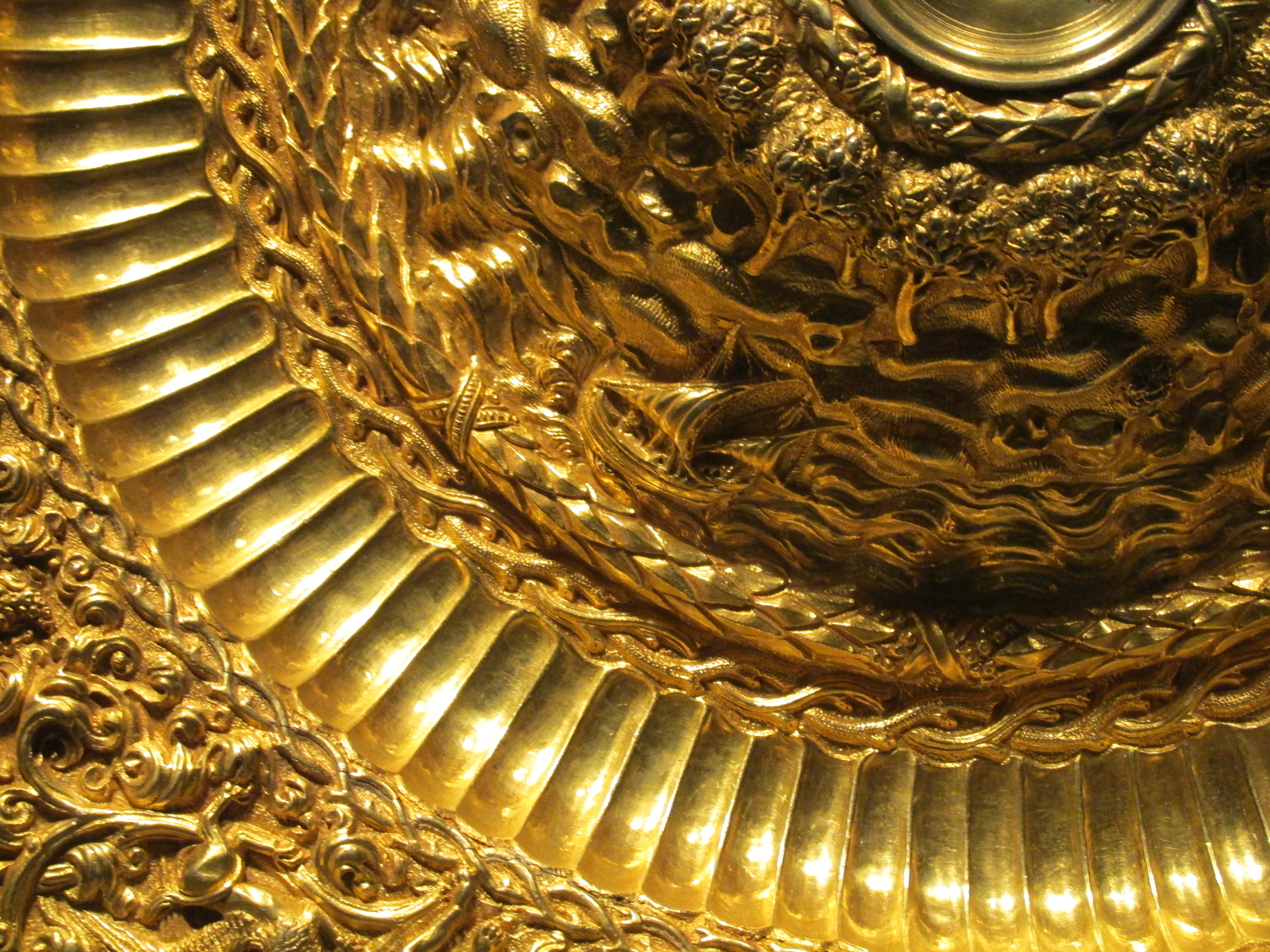
A feature of the exhibition is the diverse range of Christian artwork created at ports such as Goa and Nagasaki and on loan from Portugal and India. Especially this large golden salver used in religious ceremonies and illustrating the Manueline taste of the period. When filled with water the central part represented an island surrounded by the sea.

IMG_1017 - Copy

It is decorated with animals, foliage and a maritime scene of a caravel in stormy seas.

IMG_1025

Speaking of stormy seas the Jesuit priest Saint Francis Xavier sailed to Goa, then Malacca and then the Spice Islands to bring the Christian message to the Eastern Seas. A frightful storm arose off Ambon and the saint immersed his cross in the water to calm the seas but the cross was lost in the water. It is believed that later when Saint Francis was walking on the beach a crab emerged from the sea holding the cross in its claws and the cross was later enshrined in this silver reliquary.

IMG_0947 - Copy

The Portuguese, Dutch and English traders soon learned of the popularity of Indian textiles throughout the archipelago and that textiles could replace silver as a trading currency. Here is a baju or jacket in the style of Indian chintz and a sembagi or waist wrap garment made in India and both found in Indonesia.

IMG_0968

Court garments like this voluminous dodot waist wrap were popular with the aristocracy throughout Indonesia and have often been preserved as heirloom items.

IMG_0979 - Copy

The most valued Indian cloth was the patolu or double ikat cloth from Gujarat such as this one displaying a procession of elephants with their royal passengers and foot-bearers found in Indonesia.

Elephant patula

Here is the Rice Godess Dewi Sri and her consort Mas Sadono seated in front of a Gujurati patolu with a ‘flowering basket’ design. Mas Sadono is also wearing an Indian silk patolu cloth as a waistwrap under his belt.

IMG_1120 - Copy

The exhibition will be at the Art Gallery of South Australia until the end of August when it will move to the Art Gallery of Western Australia until the end of January.

IMG_0995 - Copy


ianburnetbooks.com

Posted in Uncategorized | Tagged , , , , , | Leave a comment

Terra Australis 1606

Terra Australis 1606: The Voyages of the Duyfken & the San Pedrico
Tuesday, 16 June 2015, 12:30pm – 1:30pm
Venue: SMSA Mitchell Theatre
280 Pitt Street
Sydney NSW 2000

Hendrik Hondius 1641 State Library of NSW

Hendrik Hondius 1641
State Library of NSW

Maritime historian Ian Burnet discusses the background of these significant voyages, and their impact on subsequent events. Although Torres’ charts of his crossing were lost, Ian will review the available maps showing their voyages and reveal Australia’s first appearance on a subsequent world map.

The year 1606 saw Europeans sighting Australia twice.

The voyage of the Duyfken, captained by William Janszoon, is as important to Australian history as the Santa Maria is to Americans, producing the first chart of the Australian coastline. Reaching the west coast of Cape York, in northern Queensland, the crew of the Duyfken were the first Europeans to set foot on the continent. Their meeting with the local people was the first documented contact between the Indigenous Australians and Europeans.

Just months later, a Spanish expedition was looking for the reputed Terra Australis, the Great Southern Land of legend. After an unsuccessful search, the expedition split and second-in-command Luis de Torres, sailed west in his own ship, the San Pedrico, and a 20 foot launch. He eventually navigated the Torres Strait while contending with fierce storms and reached the Cape York Peninsula.

FREE & OPEN TO THE PUBLIC

The replica Duyfken at Banda

The replica Duyfken at Banda

Posted in Uncategorized | Tagged , , , , , , | 1 Comment

Treasure Ships: Art in the Age of Spices — Symposium

Treasure Ships: Art in the Age of Spices is the first major exhibition in Australia which presents the complex artistic and cultural interactions between Europe and Asia from the 16th to 19th century, a period often referred to as the ‘Age of Spices’.

If you are planning on attending the exhibition why not join the one day symposium on Saturday June 13.

Treasure Ships: Art in the Age of Spices

Treasure Ships: Art in the Age of Spices

Join us for a one day symposium with exhibition curators James Bennett and Rusty Kelty and fellow scholars Ian Burnet, Father Warner D’Souza and Joanna Barrkman for a lively exploration of the artistic and cultural interactions between Europe and Asia during the ‘Age of Spices’.

Topics include the preservation of Christian art in India, the history and trade of exotic spices of Eastern Indonesia and the role and influence of Indian textiles in trade throughout the Indonesian archipelago.

When Saturday 13 June, 11am – 3pm
Where Art Gallery of South Australia, Radford Auditorium
Cost $45, $35 Members/Concession
Bookings essential Call 08 8207 7035 or Book online

All registrants are invited to attend lunch and post symposium drinks in the Function Room

Full Program
11am
Welcome
Nick Mitzevich, Director, Art Gallery of South Australia

11.05am
Introduction and overview
James Bennett, co-curator, Treasure Ships: Art in the Age of Spices and Curator of Asian Art, Art Gallery of South Australia

11.15am
Journeys around the Spice Islands
Ian Burnet, author, scholar and adventurer.
A talk about the history, romance and adventure of the spice trade from Eastern Indonesia over a period of 2000 years, and how this drove ‘The Age of Discovery’.

11.50am
Preserving the heritage of Christian art in India and setting up the Museum of the Archdiocesan of Bombay
Father Warner D’Souza, a priest of the Roman Catholic Archdiocese of Bombay, Fr Warner speaks of his passion, inspiration and challenges encountered in the establishment of a heritage museum in Bombay.

12.30pm
lunch Break in the Function Room and exhibition viewing
Including a book signing by Ian Burnet – 1pm

1.30pm
Encounters with traces of Indian trade cloths in Eastern Indonesia and Timor-Leste
Joanna Barrkman, PhD candidate at the Australian National University researching the Baguia Collection.
This talk recounts encounters with Indian trade cloths and elucidates some of the key styles of cloths that were popular for trade into the Indonesian archipelago.

2.15pm
Guns, Christians, gold and lacquer: The arrival of the southern barbarians and their black ships
Russell Kelty, co-curator, Treasure Ships: Art in the Age of Spices and Assistant Curator of Asian art, Art Gallery of South Australia
The arrival of the Portuguese at the tiny island of Tanegashima in 1543, off the southern coast of Japan, was the first recorded contact between Japanese and the Europeans and initiated the nanban or ‘southern barbarian’ era. The art created during this era evokes the cross cultural atmosphere at ports along the spice trade routes particularly at the terminus of Nagasaki. The annual arrival of the Portuguese black ships and their exotic menagerie depicted on Japanese screens as well as sacred Christian paintings embellished with Japanese gold and black lacquer portray the confluence of European and Japanese aesthetics which took place during this era.

3pm
Panel discussion and Q&A

3.30pm
Post symposium drinks in the Function Room

Treasure Ships: Art in the Age of Spices

Treasure Ships: Art in the Age of Spices

Posted in Uncategorized | Tagged , , , , , , , , | Leave a comment

Insight Indonesia –Spice Islands Saga

I realised that the 2011 Berita Satu/Jakarta Globe TV interview on Spice Islands for Insight Indonesia had never been posted to the blogsite. I hope you find it interesting.

Posted in Uncategorized | Tagged , , , , , , , , , | Leave a comment

The Spice Islands — Underwater

Moluccan Spice Discovery 2012

Moluccan Spice Discovery 2012

The seas of the Moluccas (Maluku) in Eastern Indonesia have pristine waters and some of the greatest variety of marine life on the planet. On our 12 day voyage from Ambon to Banda to Ternate the Ombak Putih will usually find a suitable site for snorkelling and underwater exploration every day.
Here is an image of one of the members of our Spice Routes/Spice Wars 2014 sailing adventure with the Ombak Putih in the background.

Another day, another dive site

Another day, another dive site

Thanks to Randall Rutledge for the use of his underwater photographs taken on our 2014 Spice Routes/Spice Wars voyage and here are some examples of the clarity of the water and the variety of beautiful tropical fish.

Spice Islands underwater

Spice Islands underwater

OLYMPUS DIGITAL CAMERA

OLYMPUS DIGITAL CAMERA

A beautiful collection of soft corals

OLYMPUS DIGITAL CAMERA

OLYMPUS DIGITAL CAMERA

And strange sea creatures

OLYMPUS DIGITAL CAMERA

OLYMPUS DIGITAL CAMERA

East Indies Spice Exploration 2015
The Ombak Putih will be sailing again, September 26 to October 7 from Maumere on Flores to the Banda Islands and then to Ambon.
Details are available on this blogsite and from SeaTrek Sailing Adventures.

ianburnetbooks.com

Posted in Uncategorized | Tagged , , , , , , , , | Leave a comment

Ubud Food Festival, 5-7 June 2015

Mari Makan Competition Graphic

Food Forum | The Spice Islands Friday June 5, 2:30pm, at Taman Baca

For a serving of spice island history, Ian Burnet will dish up a tale of the high seas and colonial rule focusing on Indonesia’s legendary spices, cloves and nutmeg.

Spices-300x300

Fascinated by its rich history and diverse cultures, Ian Burnet has lived, worked and travelled in Indonesia for 30 years. His two historical books – Spice Islands and East Indies – are highly revered, while his third, Archipelago – a personal story of a journey across the archipelago, will be published this year.

Ian-Burnet-274x300

Please go to the Ubud Food Festival website for the full Program

FoodFestivalBanner

Posted in Uncategorized | Tagged , , , , , , , , , , , | Leave a comment

Fort Nieuw Victoria, Ambon — A Mystery Solved?

A fort on this location was built by the Portuguese in the 1500’s and then captured by the first war fleet commissioned by the United Dutch East India Company in 1605 and commanded by Steven van de Hagen. The fort was the first permanent settlement of the VOC in the East Indies and the first three Governor’s-General of the VOC were based here, prior to the establishment of Batavia in 1619.

The first Governor-General was Frederick de Houtman from 1605-1611, who happened to speak fluent Malay as a result of his eighteen month imprisonment by the Sultan of Aceh. A painting of Ambon and a greatly exaggerated Fort Victoria hangs in the Rijksmuseum in Amsterdam with an adjacent cartouche showing an image of Frederick de Houtman. The cartouche that is painted out is where Frederick de Houtman apparently claimed credit for the capture of the fort, credit which belonged to Steven van de Hagen.

Fort Victoria

Fort Victoria

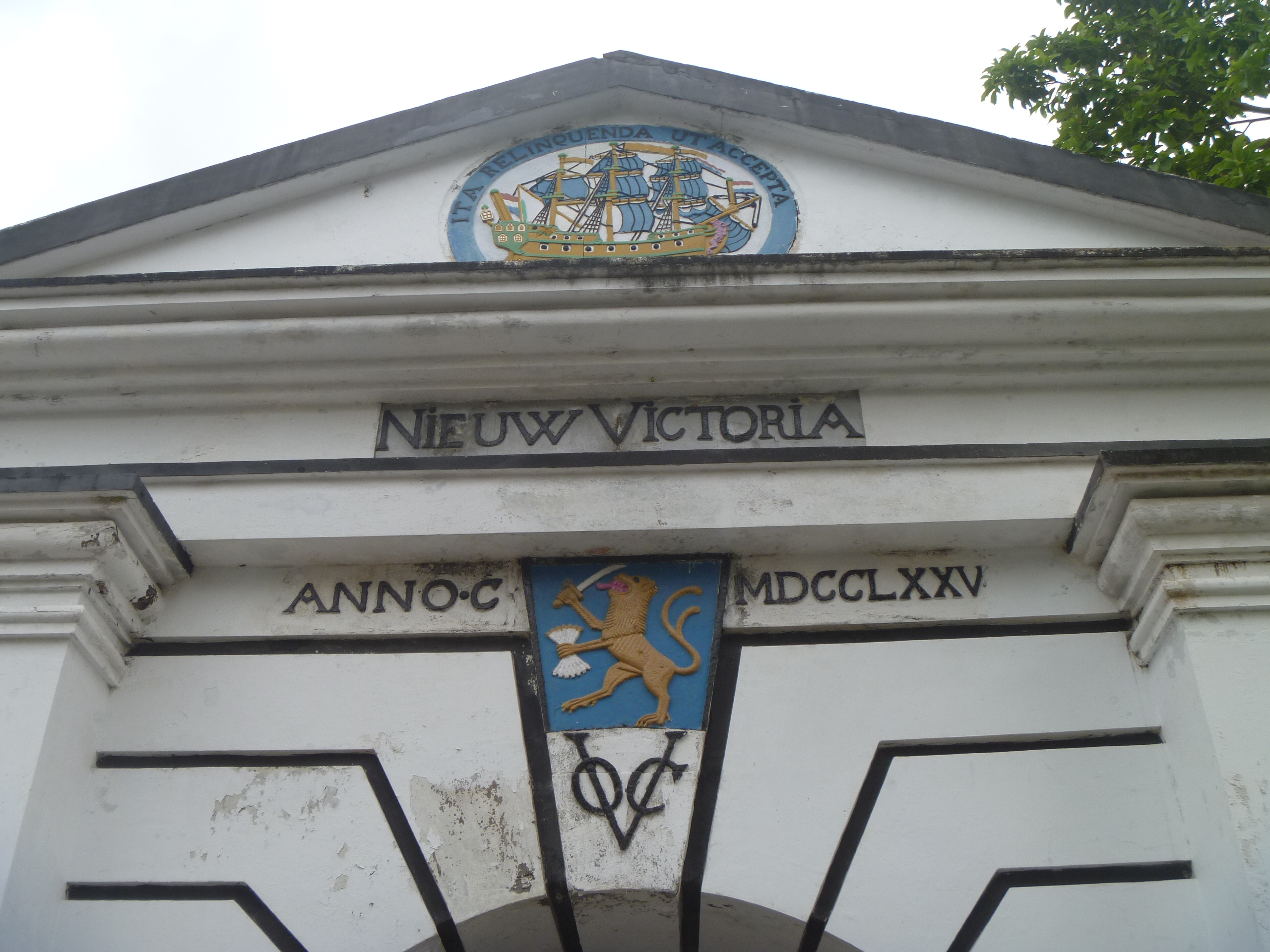
The fort was severely damaged by an earthquake in 1754 and rebuilt as Fort Nieuw Victoria. Ambon and its surrounding islands became more important to the VOC as it was here that they concentrated their clove plantations so as to control and monopolize the production of cloves from the Moluccas.
Fort Nieuw Victoria is still a military base so there is no public access and even photography of the outside of the fort is forbidden. When I visited I was able to see a very impressive changing of the guard ceremony (no photographs allowed) and tried to convince the guard on duty if I could take a photograph of the historic entrance, no success until one of the commanding officers came along and said “ok, let that crazy foreigner take his photo, but remember only the entrance”.

Fort Nieuw Victoria 1755

Fort Nieuw Victoria 1755

Each of the bastions is named and on exploring the outer walls I found Groeningen and Hollandia but could not get access to the others.

Fort Nieuw Victoria

Fort Nieuw Victoria

Bastion Hollandia

Bastion Hollandia

Near the northwest bastion I found a plaque with the words Adriana Iohanna (Johanna?) which I assumed to be a name or names, and I was curious as to its significance.

Adriana Johanna

Adriana Johanna

Could this be Adriana de Stuers-de Kock? Her father headed the Dutch contingents that fought against Diponegoros’ armies in the ‘Java Wars’. Adriana was born in Surabaja in 1809, grew up in Batavia, and married her father’s adjudant in 1828. In 1837 her husband was appointed governor of the Moluccas. Unfortunately the ship carrying the new governor and his family founded on a coral reef on route to Ambon. Here the 140 passengers and crew including Adriana, who was now expecting her fifth child, managed to survive by clinging to the reef and the wreck. After four weeks of this ordeal they were finally rescued and brought to Ambon.

Is this the same Adriana on the plaque or somebody else? My thanks to Abe Smits a voyager on our 2014 Spice Routes/Spice Wars sailing adventure who brought the name of Adriana Johanna Bake to my attention.

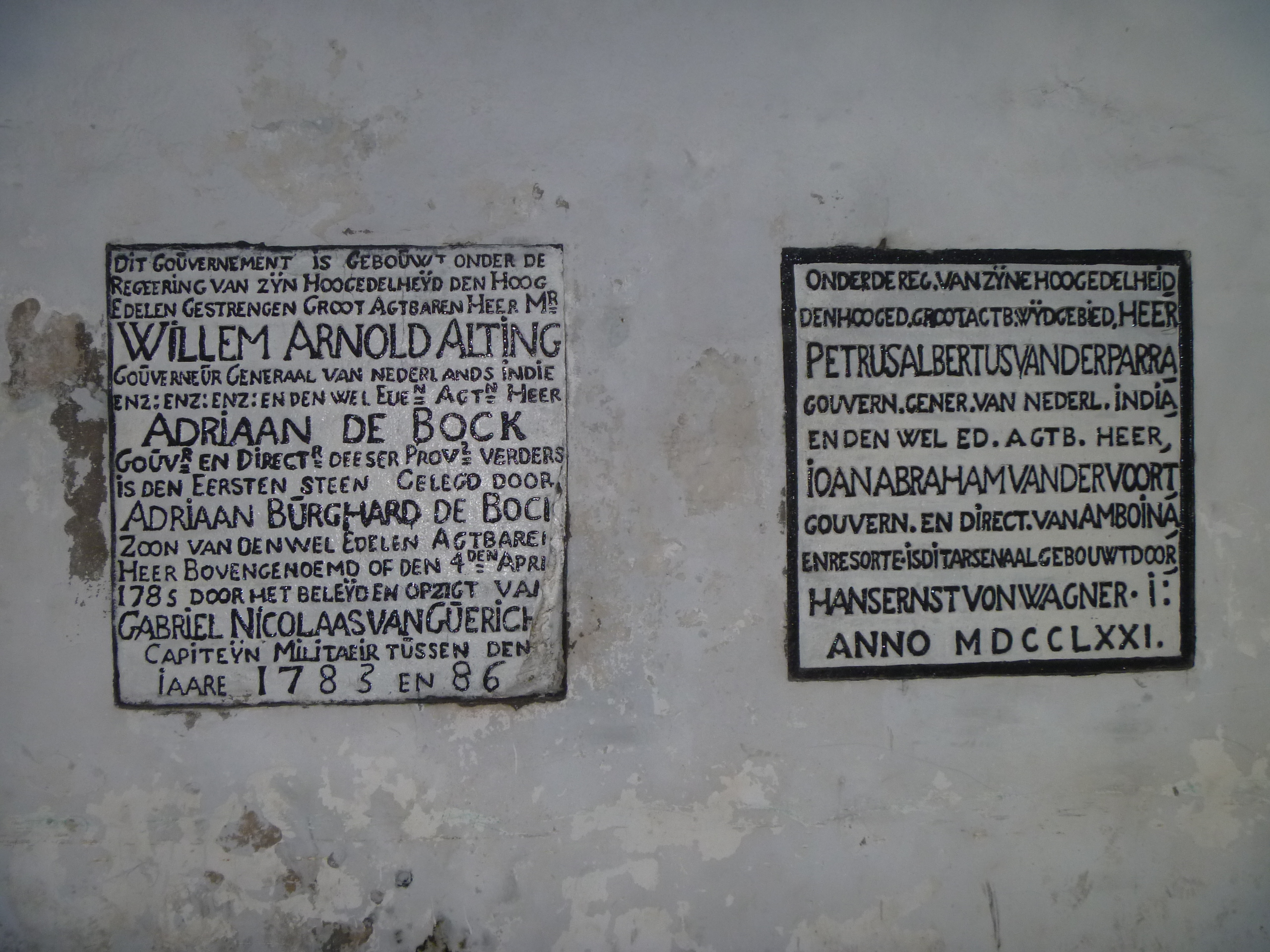
It now seems more likely that the plaque is for Adriana Johanna Bake who was born in Ambon in 1724 and married in 1743 in Batavia to Petrus Albertus van Parra who became Governor-General of the East Indies in 1761, and for whom an inscription is seen on the entrance to the fort. Of course we still need to know the significance of the plaque in her name, but we can imagine her visiting the town of her birth and newly rebuilt Fort with her husband the Governor-General and being honoured in this way.

P1010999

ianburnetbooks.com

Posted in Uncategorized | Tagged , , , , , , | Leave a comment