SIGNALS – Tasman Map Book Review

Signals001

History Underfoot by Jeffrey Mellefont

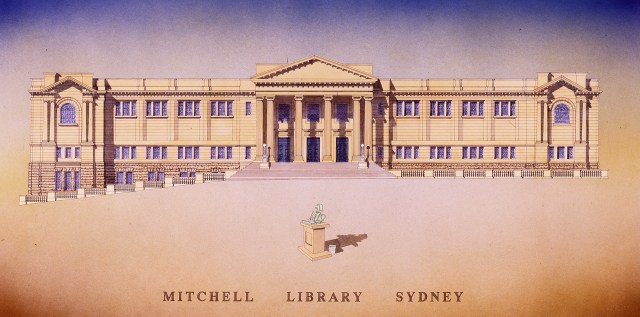
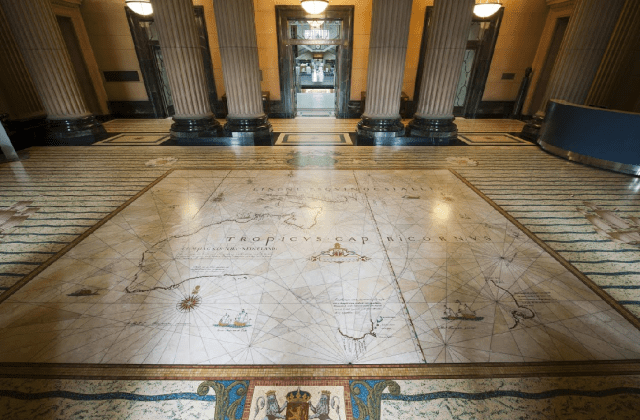
Like me, many Signals readers will have entered the State Library of NSW through the northern portico of the Mitchell Library and then crossed the vestibule to the muted reading room that’s so solemn with generations of scholarship. Every time we do, we tread the cool marble and terrazzo of the entrance floor, but – if your like me – on most visits we scarcely register the huge map of an earlier, incompletely charted Australia that’s reproduced beneath our feet.

67 Mitchell-Library-State-library-NSW-Simon Fieldhouse

Northern  facade of the Mitchell Library – drawn by Simon Fieldhouse

The details are finely delineated by brass lines inset into marble in a medium that might be as much cloissoné as it is mosaic – details such as the radiating compass roses or the elegant little cameos of sailing ships, or annotations in copperplate Dutch. If we’ve paused we’ve probably noted the signage telling us it’s Abel Tasman’s map … and then marched straight on into the reading room.

68 Tasman Map from wall Image

The Mitchell Library Vestibule and the marble mosaic Tasman Map – State Library NSW

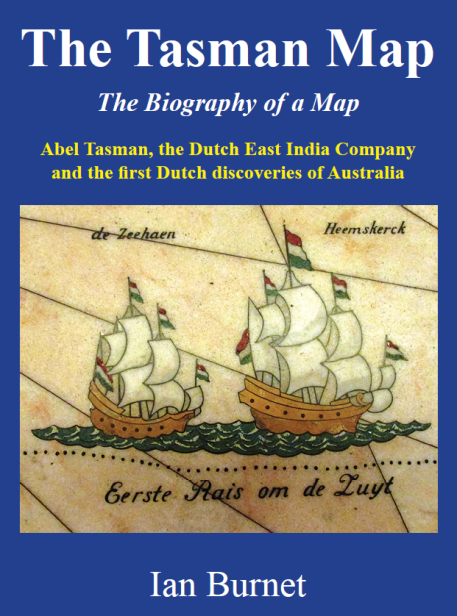
Author Ian Burnet would like us to realise that the beautiful reproduction underfoot is what he considers to be Sydney’s greatest work of public art, of the indoors variety. Burnet has made the Library’s Tasman Map both the beginning and the end of his fifth book of regional history for interested but not-necessarily-academic readers – readers like you and me. Between these bookends he tells the story of how our variously named island continent – Terra Australis Incognita, Jave Le Grande, t’Zuyd Landt, Hollandia Nova – took its physical cartographic outline.

Rosenberg Front Cover Image

As with his previous books, Burnet provides a richly detailed  but easily digested context for the big global movements involving the rising Catholic and Protestant maritime powers of Western Europe, before going on to summarise all the players who contributed to the map in the library vestibule. There are those who almost everybody knows  – Willem Janszoon of the Duyfken; Dirk Hartog of pewter plate fame; Francois Pelsaert of the frightful Batavia tragedy; Jan Carstenz attacked by aborigines while charting the Gulf of Carpentaria; Frederick de Houtman at the treacherous West Australian Abrolhos reefs; Francois Thijssen sailing off-course on the Gulden Zeepaard and charting Cape Leeuwin and half the Bight, and many others. Followed by Abel Tasman and his voyage of 1642-43 to Tasmania and New Zealand and his 1644 voyage along the north coast of Australia.

66 Tasman Map

One of the State Library’s most valued possessions  – The 1644  Bonaparte Tasman Map

Just as fascinating as these voyages is Burnet’s account of how the Mitchell Library acquired two priceless treasures of Tasman’s contribution to Australian discovery. One of only two surviving hand-written copies of Tasman’s 1642-43 journal, and the Tasman Map which was prepared in Batavia in about 1644 for the directors of the United Dutch East India Company in Amsterdam.

Tasman1642_7_1642 Nov 24

The entry from the Tasman Huydecoper Journal for November 24, 1642  and the first sighting of what Abel Tasman named Van Diemens Land  (Tasmania)

The magificent marble vestibule floor based on the Tasman Map was commenced in 1939 by master craftsmen using Wombeyan russet marble with a tone resembling the varnished paper of the original. It’s bordered by green and cream terrazzo with a surrounding mosaic floor of oceanic waves. Next time you visit the Mitchell Library, give it more attention. Or buy the book. Or both.

This is an abreviation of a review, by Jeffrey Mellefont, which was first published in SIGNALS, the quarterly journal of the Australian National Maritime Museum, issue 129 (December 2019–February 2020).

If you wish to buy the book you can order from your favourite bokshop, from the usual online retailers, or if you live in Sydney I can deliver a signed copy to your door.

http://www.ianburnetbooks.com


Posted in Uncategorized | Tagged , , , , , , , , , , , , | 2 Comments

The Coral Triangle, The Rajah Ampat and Wayag Island

In early 2020 I joined the Coral Adventurer on its voyage to the Rajah Ampat and the Spice Islands.

The ‘Coral Triangle’ is the planet’s richest centre of marine life and coral diversity, with over 6,000 species of fish, 76% of the world’s coral species, and an awe-inspiring array of wildlife. Resources from the area directly sustain more than 130 million people living here. But overfishing, destructive fishing, unsustainable tourism, impacts of urbanization, and climate change are eroding this resource base.

Coral Triangle

Coral

The ‘Coral Triangle’ has the most abundance of coral species and coral reef fish species of anywhere on the planet. This is caused by the ‘Indonesian Throughflow’ between the Pacific and Indian Oceans, when a huge amount of seawater and associated marine plankton flow through the region of ‘The Rajah Ampat’.

Indonesia Flowthrough

Within the ‘Coral Triangle’ is the region of ‘The Four Kings’ that is ‘The Rajah Ampat’ which consist of the four main islands of Misool, Torobi, Batanta and Waigeo. But there are many smaller islands in the region including Wayag which is located to the northwest of Waigeo.

The Rajah Empat Islands

In May 2007, a network of seven Marine Protected Areas was formally declared by the government of the Raja Ampat regency and since then another 5 have been added across the Birds Head Peninsular – a truly impressive achievement.


RajaAmpat_-MPA-Map_400

The seven Marine Protected Areas in the Raja Ampat Marine Reserve

Wayag, which is the northernmost island in the Kawe Marine Reserve consists of a series of islands formed on a carbonate limestone topography, which have been eroded by both rainwater and seawater to form karst remnants.

Wayag 10

The Guest Lecturer doing some ‘guest lecturing’ on karst topography

Wayag

The view of the karst topograhy from the top of Wayag Island

Wayag 4

Some happy ‘Coral Adventurers’ at the top of Wayag Island


http://www.ianburnetbooks.com

Posted in Uncategorized | Tagged , , , , , , , | 6 Comments

The Sir William Dixon bronze doors at the Mitchell Library

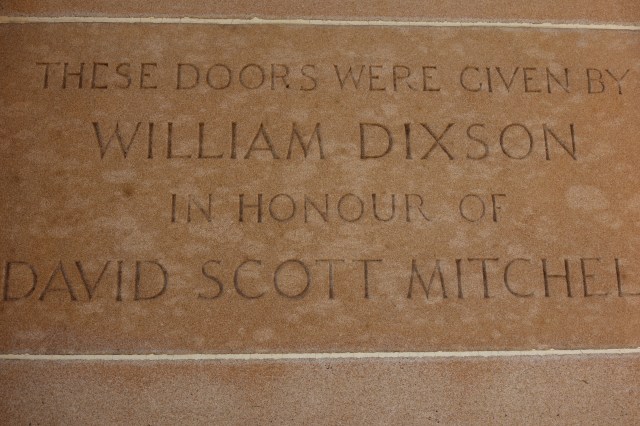
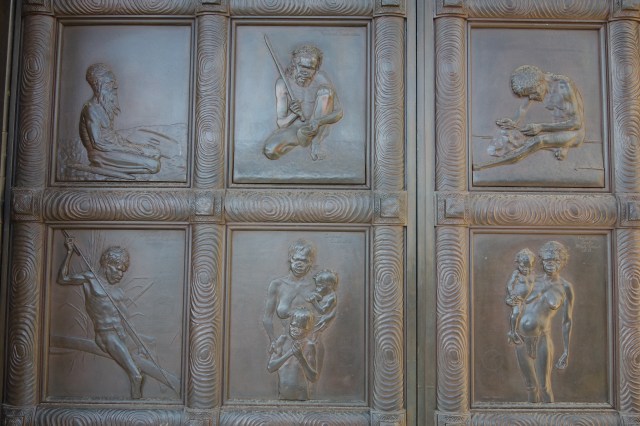
Inspired by the style of doors that graced the entries of some of America’s most significant public buildings, the bronze portico doors at the entrance to the Mitchell Library in Sydney illustrate various elements of Australian history. Principal librarian William Ifould recognised that the doors were ‘somewhat of a luxury’ and approached benefactor Sir William Dixson to donate the doors in honour of the Library’s other great benefactor David Scott Mitchell.

DSC00095

The central doors honour European explorers of Australia; the left side shows the navigators who explored Australia’s coast and the right side, the explorers who travelled inland (the individual panels identify each explorer by name). The reliefs on the bordering doors were originally planned to depict the various arts and sciences represented in the Library’s collection, but the principal librarian William Ifould rejected the concept in favour of panels illustrating scenes from the lives of the Australian Aboriginal people.

DSC00085

Planning for the doors began in the early 1930s, however Ifould’s vision for ‘a beautiful pair of bronze entrance doors’ quickly became embroiled in controversy. Much debate focused on the subject matter, particularly the Aboriginal panels, which some thought should feature portraits of governors. True to form, among the critics of Ifould’s vision for the doors was the Daily Telegraph, which commented, ‘Mr Ifould is an excellent librarian, but is he capable of judging a piece of sculpture?’

DSC00090

The bas reliefs of aboriginal figures were undertaken by seven sculptors including Queensland sculptor Daphne Mayo, Ralph Walker, Frank Lynch and E. Lenegan and the images of the aboriginal figures were taken from photos in the library’s collection.

DSCN3755

Dr John Vallance and Library staff participating in the smoking ceremony

A traditional aboriginal smoking ceremony was held on October 19, 2019 outside the Mitchell Library as part of the Open Day ceremonies for the State Library NSW.

72350859_10157900317689268_5684958350962327552_o

Elder Les Daniel conducting the smoking ceremony

DSCN3774

Elder Les Daniel and the bronze doors

http://www.ianburnetbooks.com


Posted in Uncategorized | Tagged , , , | 5 Comments

Microsoft Innovations: Empowering the Mobile Experience

Microsoft is a global technology leader, constantly driving innovation and transforming the digital landscape. With cutting-edge mobile applications and cloud solutions, the company enables users to work, learn, and enjoy entertainment wherever they are.

Innovative Solutions for Business and Personal Use

Products such as Office 365 and the Azure platform have revolutionized the way both businesses and individuals operate. Microsoft’s mobile solutions provide seamless access to essential tools, ensuring productivity and connectivity on the go.

Security and Reliability

Security remains a top priority for Microsoft. Regular updates and advanced protection technologies guarantee that users’ data stays secure, whether they’re managing business tasks or accessing personal information.

Discover More

Committed to making technology accessible for everyone, Microsoft continues to innovate and grow. To explore the latest developments and learn more about their diverse range of products, visit the official website at Microsoft.

Posted in Uncategorized | Leave a comment

Microsoft Innovations: Empowering the Mobile Experience

Microsoft is a global technology leader, constantly driving innovation and transforming the digital landscape. With cutting-edge mobile applications and cloud solutions, the company enables users to work, learn, and enjoy entertainment wherever they are.

Innovative Solutions for Business and Personal Use

Products such as Office 365 and the Azure platform have revolutionized the way both businesses and individuals operate. Microsoft’s mobile solutions provide seamless access to essential tools, ensuring productivity and connectivity on the go.

Security and Reliability

Security remains a top priority for Microsoft. Regular updates and advanced protection technologies guarantee that users’ data stays secure, whether they’re managing business tasks or accessing personal information.

Discover More

Committed to making technology accessible for everyone, Microsoft continues to innovate and grow. To explore the latest developments and learn more about their diverse range of products, visit the official website at Microsoft.

Posted in Uncategorized | Leave a comment

The Dutch Prime Minister and the Tasman Map


Mark Rutte

The Prime Minister of the Netherlands is appointed as an Honorary Companion of the Order of Australia

The Prime Minister of the Netherlands, Mr Mark Rutte, spent three days on a working visit to Sydney and Melbourne from 9 to 11 October 2019.

Mr Rutte’s busy schedule began at Admiralty House where he was appointed an Honorary Companion of the Order of Australia for his exceptional leadership to establish the MH17 Joint Investigation Team.

He then met with Prime Minister Morrison for bilateral talks, which included discussions on MH17, strengthening the trade and investment relationship, the circular economy and opportunities for closer international cooperation.

Later in Sydney, Mr Rutte toured the State Library of New South Wales to view items of Dutch-Australian heritage. He also attended business events at the Sydney Opera House, met with the Premier of New South Wales and delivered a keynote speech at the Lowy Institute where he said:

“I believe that Australia and the Netherlands should work closely together in pursuing that goal. I believe that for many reasons. Because we share a long history, going all the way back to the early 17th century, when the Dutch ship Duyfken – the little pigeon – landed in northern Australia.

It was a wonderful experience yesterday at the State Library of New South Wales to see the maps and journals documenting these first encounters between Australia and Europe”.

Mark Rutte at the SL. 2 jpg

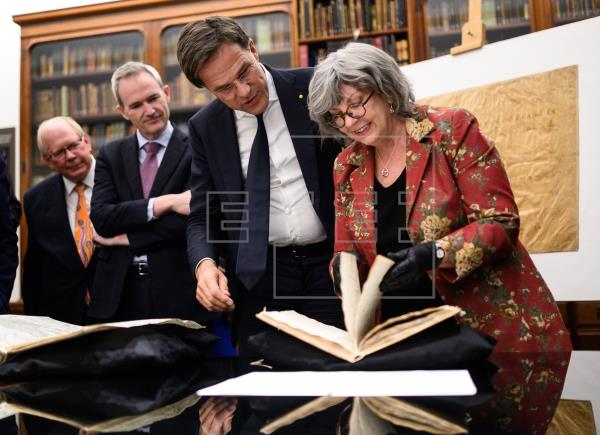
Prime Minister Rutte viewing the Tasman Huijdecoper manuscript at the State Library with the Tasman Bonaparte Map in the background.

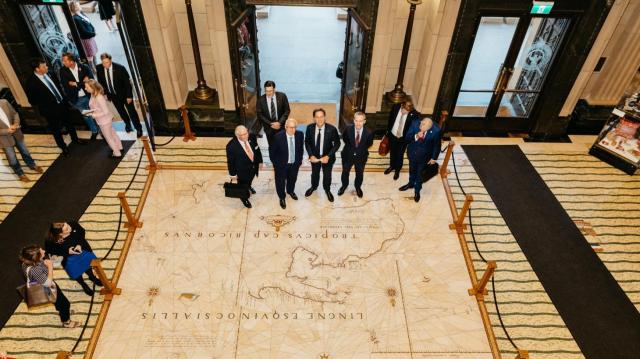
Prime Minister Rutte visited the State Library of New South Wales where State librarian Dr John Vallance welcomed PM Rutte in the Mitchell Vestibule with the Tasman Map mosaic floor. PM Rutte was also able to closely observe the original Tasman Map, one of the State Library’s most valued possessions, along with the Huijdecoper manuscript by Tasman and Blaeu’s Atlas Major.

Dutch PM

Prime Minister Rutte being welcomed in the Mitchell Library vestibule with the magnificent marble mosaic of the Tasman Map

Rosenberg Front Cover Image


http://www.ianburnetbooks.com


Posted in Uncategorized | Tagged , , , , | Leave a comment

THE GLOBE – Tasman Map Book Review

Globe001

The Tasman Map , also known as the Bonaparte Tasman Map, is a prize possession of the Mitchell Library in Sydney. It was bequeathed to the Library, though in a rather roundabout fashion explained in detail in Chapter 27, by Prince Roland Bonaparte. President of the Geographical Society of France and grandnephew of Napoleon I. Compiled over the period from 1606 to 1644, the Tasman Map shows Australia and some neighbouring islands. It was drawn in Batavia either by or under the direction of Isaac Gilsemans, who had been supercargo on the Zeehaen travelling with Tasman in his voyage on the Heemskerk in 1642/43 during which some of the major features of the Tasman Map were charted. It is hand-drawn on Japanese paper. The map is also displayed as a mosaic in marble on the vestibule floor in the Mitchell Library.

Lost and Found 2


The subtitle of ‘The Biography of a Map’ is a very apt description of the way the story of the construction of the Tasman Map is presented. The Tasman Map is the compilation of sixteen separate discoveries in the Australia-East Indies region beginning with the Portuguese in the sixteenth century. Each of the cartographic steps is presented with detailed accounts of the people involved. Including their personal lives and their roles in the processes that brought traders from Europe to the East Indies. This is the ‘biography’ of the map and it gives the book extra substance and makes for a rich reading experience.

Rosenberg Front Cover Image

An interesting feature of this book is that it raises for the reader many ‘What if’ questions about the discovery, mapping and settlement of Australia. What if one of the Dutch attempts to sail through what is now the Torres Strait had been successful and they had discovered and mapped the east coast of Australia? What if Tasman had sailed directly north after leaving Tasmania and encountered Australia’s eastern coast rather than New Zealand? What if the VOC had been run by a more inquisitive group? For me, one of the interesting outcomes of reading this book is the realization that this period of exploration of this part of the world was driven almost exclusively by commercial considerations.

Ian Burnet has presented a detailed and authoritative account of the construction of the Tasman Map and its subsequent history. But he goes a lot further than that. The depth of the social and political history contained here is impressive in the way it provides an insight into the contemporary conditions and the people involved. I have enjoyed reading it and learnt a great deal.

Brian Finlayson, School of Geography, University of Melbourne.

http://www.ianburnetbooks.com


Posted in Uncategorized | Tagged , , , , , , , | Leave a comment

The Tasman Map – A short documentary

Lost and Found

Lost and Found 2

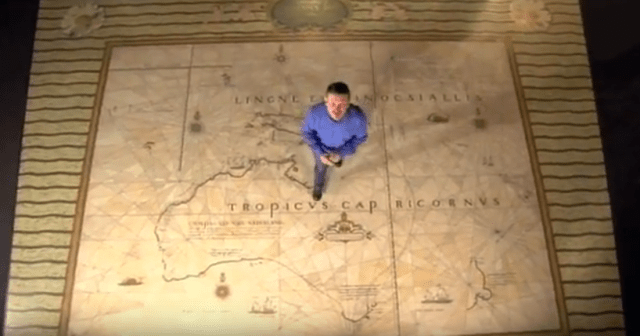
The marble mosaic of the Tasman Map in the vestibule of the Mitchell Library

Follow the link to watch a short video (5minutes) from the State Library of NSW on the history of the Tasman Map

http://www.youtube.com/watch?v=ZuTRL9qSrmI

Rosenberg Front Cover Image

‘Ian Burnet in this stunning volume brings alive the many voyages of discovery that linked the exploration and Dutch conquest of Indonesia to a growing awareness on the part of the Dutch of the great, but as yet unknown, land to the south. Burnet, chapter by chapter with stunning illustrations and reproductions of early maps, has managed to document the many voyages from Europe to the “far east”.

Most of us will have heard of parts of Burnet’s story, whether it is of figures such as Francis Drake, Dirk Hartog or Abel Tasman, or of place names which reflect historical moments in our history, such as the Gulf of Carpentaria, Arnhem Land, Groote Eylandt, Rottnest Island, or Maatsuyker Island. But other parts of his story will be new to many.

This is a book to savour and to learn from and which will serve as a reference to many a historical event of relevance to both Indonesia and Australia’.

Dr. Ron Witton – Inside Indonesia

http://www.ianburnetbooks.com

Posted in Uncategorized | Tagged , , , , | 1 Comment

The Tasman Map – Book Review

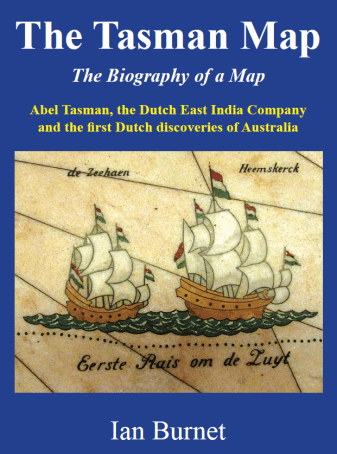
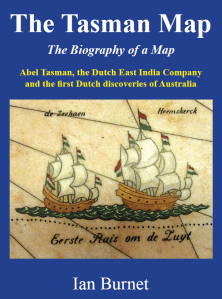
Ian Burnet, The Tasman Map – The Biography of a Map: Abel Tasman, the Dutch East India Company and the first Dutch Discoveries of Australia, Rosenberg Publishing Pty Ltd, 2019

Rosenberg Front Cover Image

Having grown up in Sydney, I can remember as a student visiting the Mitchell Library in the 1950s. My memories are of a large and impressive reading room but I must confess that I paid little attention as to how I arrived in the reading room after passing through the front entrance. I now realise that to do so, I had to traverse one of the most remarkable sights in Australia: a mosaic of the Bonaparte Tasman map in the vestibule:

68 Tasman Map from wall Image

The marvellous marble mosaic Tasman Map in the vestibule of the Mitchell Library

This map graphically illustrates the voyages of Abel Tasman and how his voyages of discovery produced the first recognisable image of the Australian continent. What is of particular interest to me, given my interest in Indonesia since my student days, is that this pictorial record Tasman’s voyages south from the Dutch East Indies demonstrates how interlinked are the early histories of Europe’s voyages of discovery to Indonesia and Australia.

Ian Burnet in this stunning volume brings alive the many voyages of discovery that linked the exploration and Dutch conquest of Indonesia to a growing awareness on the part of the Dutch of the great, but as yet unknown, land to the south. Burnet, chapter by chapter with stunning illustrations and reproductions of early maps, has managed to document the many voyages from Europe to the “far east” by way of both the Cape of Good Hope and Cape Horn that managed to create in Europe a global awareness of the world. It is a tale of the rise of English and Dutch mercantile capitalism, and the subsequent decline of the Portuguese and Spanish feudal empires, the many ways that the “east” and the “west” interacted, the fortunes that were made, the horrors that many ordinary people experienced, and the way the foundations of the modern world were laid in our part of the globe.

Most of us will have heard of parts of Burnet’s story, whether it is of figures such as Francis Drake, Dirk Hartog or Abel Tasman, or of place names which reflect historical moments in our history, such as the Gulf of Carpentaria, Arnhem Land, Groote Eylandt, Rottnest Island, or Maatsuyker Island. But other parts of his story will be new to many. There is the tale of how the tiny spice island of Rhun, lying to our north and claimed by the English was subsequently “swapped” for Manhattan Island that had been claimed by the Dutch. There is the horror story of the wreck of the Batavia on the Western Australian coast where a mutiny among the survivors led to a massacre and an eventual bringing to horrific justice of the perpetrators. The many voyages in our part of the world, such as that of the Duyfken, a replica of which recently sailed around Australia, are brought to life through Burnet’s judicious use of contemporary chronicles, logbooks, paintings and maps.

25 Duyfken replica at Banda

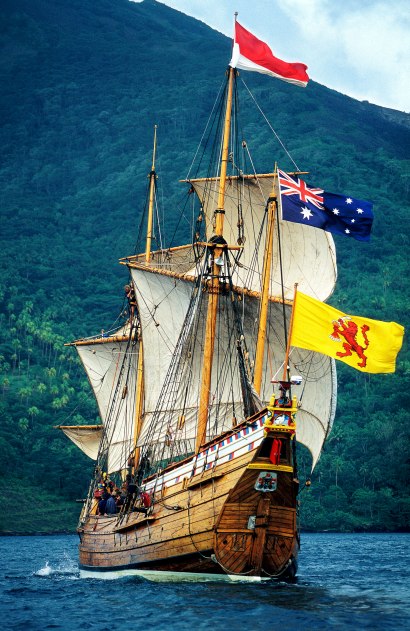
The Duyfken replica ship ready to depart from the Banda Islands during the re-enactment of the voyage leading to the Dutch discovery of Australia. (Robert Garvey)

The book also reminds us that Abel Tasman was the first European to circumnavigate Australia despite the fact that for much of his travels he was not in sight of land. However, his two great voyages managed to piece together the disparate understanding of the relationship of our continent to the islands to our north that had slowly arisen through previous voyages, many of which are documented by Burnet.

66 Tasman Bonaparte Map SL NSW - enhanced

The Tasman Map – 1644

The book contains many surprises. There is the 1647 verbatim detailed description of the appearance and life cycle of wallabies written by the first Europeans to encounter such, to European eyes, strange beasts. There is the fact that the great flowering of Dutch art in the 1600s typified by such figures as Rembrandt, Johannes Vermeer and Frans Hals, was a direct result of the fabulous fortunes made from the spice islands to our north. There is the more recent amazing tale of how Daisy Bates, while living in the 1920s with remote Aborigines in the Nullarbor Plain, was instrumental in having one of rarest maps in the world, that of the Bonaparte Tasman Map, donated to the Mitchell Library by one of Bonaparte’s descendants.

This is a book to savour and to learn from and which will serve as a reference to many a historical event of relevance to both Indonesia and Australia.

Dr.Ron Witton —  forthcoming in Inside Indonesia

http://www.ianburnetbooks.com


Posted in Uncategorized | Tagged , , , , , , , , , | 4 Comments

The first appearance of the Spice Islands on a world map – the Atlas Miller (1519-1522)

Art and science join forces in the Portuguese atlas known as the Atlas Miller by the cartographers Lopo Homem, Pedro Reinel, Jorge Reinel and the miniaturist António de Holanda, which is one of the wonders of sixteenth-century Portuguese cartography. The Atlas was created for the Portuguese King Manuel and was intended to display the wealth and power that Portugal had derived from its discoveries in Africa, India, South East Asia and the lands it had claimed.

Based on the map by  the Greek geographer Claudius Ptolemy from the second century AD of the known world, the planisphere of the Atlas Miller shows the Atlantic and Indian Oceans bounded by land.

Miller Planisphere

Planisphere of the known world from the Atlas Miller (1519-1522)

This masterpiece of geographic art portrays the known world before the departure of Ferdinand Magellan and his Armada de Moluccas, 500 years ago in 1519. This map of the world changed forever after the Armada de Moluccas found their way through the Strait of Magellan and then across the vast Pacific Ocean before they reached the Spice Islands in 1521.This voyage would become the greatest voyage in maritime history when the vessel Victoria captained by Juan Sebastian Elcano completed the first circumnavigation of the globe in 1522.

29_MagellansVoyage_BattistaAgnese1544_LC

The first circumnavigation of the world by Magellan/Elcano  (Battista Agnese 1544)

Alfonso de Albuquerque aided by his Portuguese and Malabari forces had captured the strategic Asian city of Malacca in 1511 and the geographical depiction of the Malay Peninsula, Sumatra and the Riau Islands south of Singapore from the Atlas Miller are reasonably accurate even though the artistic illuminations by António de Holanda show the fantastic.

Miller Atlas Mallacca

Detail of the map of the Malay Peninsula from the Atlas Miller

Only a few months after the capture of Malacca, three Portuguese ships under the command of Antonio de Abreu sailed eastwards towards the Spice Islands. The small fleet comprised the flagship Santa Caterina, the Sabaia captained by Francisco Serrao and an unamed caravel captained by Alfonso Bisagudo. They were a crew of 120 including 60 Malays and Javanese, their pilot Nhahkoda Ishmael who was familiar with the trading route to the Spice Islands and Francisco Rodrigues the Portuguese pilot who chronicled their voyage. The fleet reached the tiny nutmeg islands of Banda, Api, Lontar, Ai and Run all of which are mere specks in the Banda Sea. It was after being shipwrecked on the return voyage that Francisco Serrao and his comrades were taken north to the clove islands of Ternate, Tidore, Moti, Machian and Bachan.

Miller Atlas Insulinde

The Malay Peninsula, Sumatra, Java and the islands of Eastern Indonesia from the Atlas Miller


The map of the Spice Islands from the Atlas Miller shows a mass of speculative islands however the one that shows some geographical accuracy are what appear to be the Banda islands as mapped by Francisco Rodrigues and showing the Portuguese flag .

Miller Atlas Banda detail

The Banda islands from the Atlas Miller

The chronicle and maps made by Francisco Rodrigues of the first Portuguese voyage to the Spice Islands in 1512 were lost to history until copies were discovered in 1937 in the archives of the Bibliotheque de l’Assemblee Nationale de France. Below is his more accurate depiction of the Banda islands.

Miller Atlas Banda Rodrigues

The Banda islands by Francisco Rodrigues 1512

At the top of the map of the Spice Islands in the Atlas Miller there appears to be a depiction of the clove islands of Ternate, Tidore, Moti, Machian and Bachan off the coast of Halmahera and these are probably derived by the Portuguese from either Francisco Serrao or Malay/Javanese maps of the period.

Miller Atlas Ternate

Depiction of the clove islands from the Atlas Miller


For the complete story of the European discovery of the Spice Islands and the history, romance and adventure of the spice trade over 2000 years, please order the book Spice Islands from your favorite bookstore or online retailer as a paperback or e-book.

Rosenberg_Spicejak2Final_crop - Copy (3)


http://www.ianburnetbooks.com


Posted in Uncategorized | Tagged , , , , , , , , | 7 Comments