Kasteel Batavia

Jan Pieterszoon Coen as the the fifth Governor-General of the United Dutch East Indies Company (VOC) negotiated an agreement with the Prince of Jayakarta to build a factory on the east bank of the Ciliwung River where it entered the harbour of Sunda Kelapa in 1619. In those days a factory consisted of a small fortress containing warehouses and accomodation that served as a trading post. The establishment of the Dutch factory was challenged by both the English East India Company and the Sultan of Banten. Coen was forced to sail to Ambon which was then the headquarters for the VOC to get reinforcements. He told those in the factory to hold out as best they could stating:

In the meantime try to hold the fortress as best you can. If the time should come that you can no longer hold on to the place you should try to come to some understanding with either Jacatra or the English. It is our opinion that, if such an emergency should arise, you would be better by surrendering to the English.

In the end the fortress survived and Jan Pieterzoon Coen returned with enough men and materials to build Kasteel Batavia and the adjacent walled city expanded under Dutch rule. Modelled after a typical port city in the Netherlands, it lay at sea level so that small boats had direct access to the city and the warehouses. This painting made in 1649 shows small boats loading and unloading goods from the warehouses in Batavia to the large EastIndiaman waiting to sail to the Netherlands. Kasteel Batavia is shown on the left of the main canal and the spice warehouses or the Westzijdsche Pakhuizen are on the right.
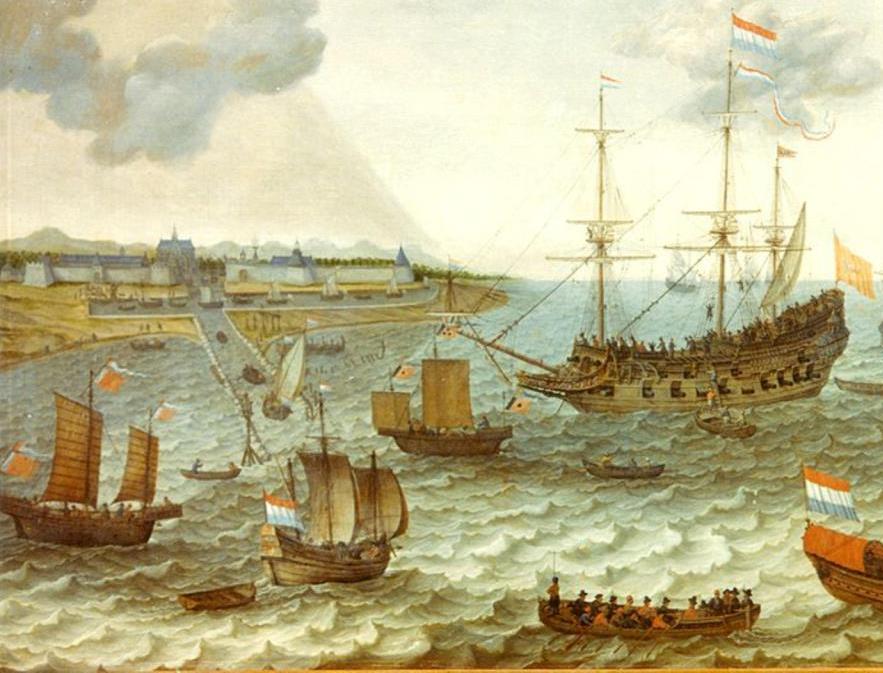
Batavia in 1649 by Adam Willaerts

Batavia in 1649 by Adam Willaerts

This map from 1780 is of Batavia at the height of the trading power of the United Dutch East India Company and shows the outline of the walled city with the Kasteel Batavia able to protect the city, the port and main canal that enters the city.

The walled city of Old Batavia

The walled city of Old Batavia

Here is a 1656 painting which shows the imposing Kasteel Batavia in the background. In the foreground there is a market scene on the banks of the main canal showing daily life in Batavia with the Dutch, Javanese, Ambonese, Chinese and Arab residents of the city.
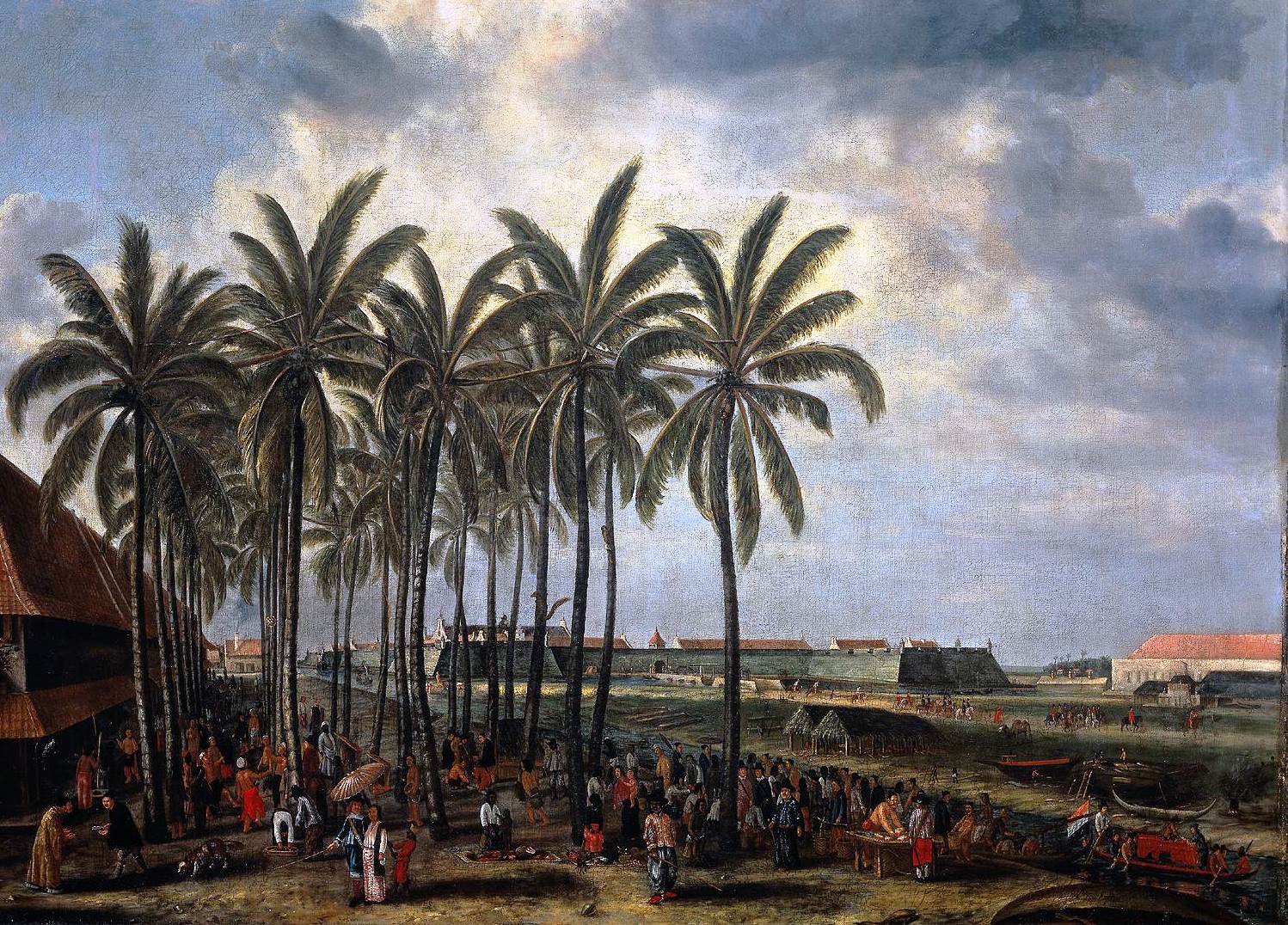
Andries Beeckman 1656 The Kasteel Batavia

Andries Beeckman 1656 The Kasteel Batavia

As this model from Museum Bahari or the Jakarta Maritime Museum shows the Kasteel was packed with the offices and buildings required to manage the vast commercial empire of the United Dutch East Indies Company which extended not just across the Indonesian archipelago but also to India, Sri Lanka, Malaya, China and Japan.

Model of Kasteel Batavia in the Museum Bahari

Model of Kasteel Batavia in the Museum Bahari

You may notice that the watergate which provided access from the canal and would have been at the bottom of this image is missing. This is because the VOC ship carrying the stone pieces of the watergate, and named the Batavia, was wrecked on the coast of Western Australia in 1629 where it remained undiscovered until 1963. Marine archeologists recovered many historic items from the site including the stern of the ship and the watergate which are now on display at the Shipwreck Museum in Perth.
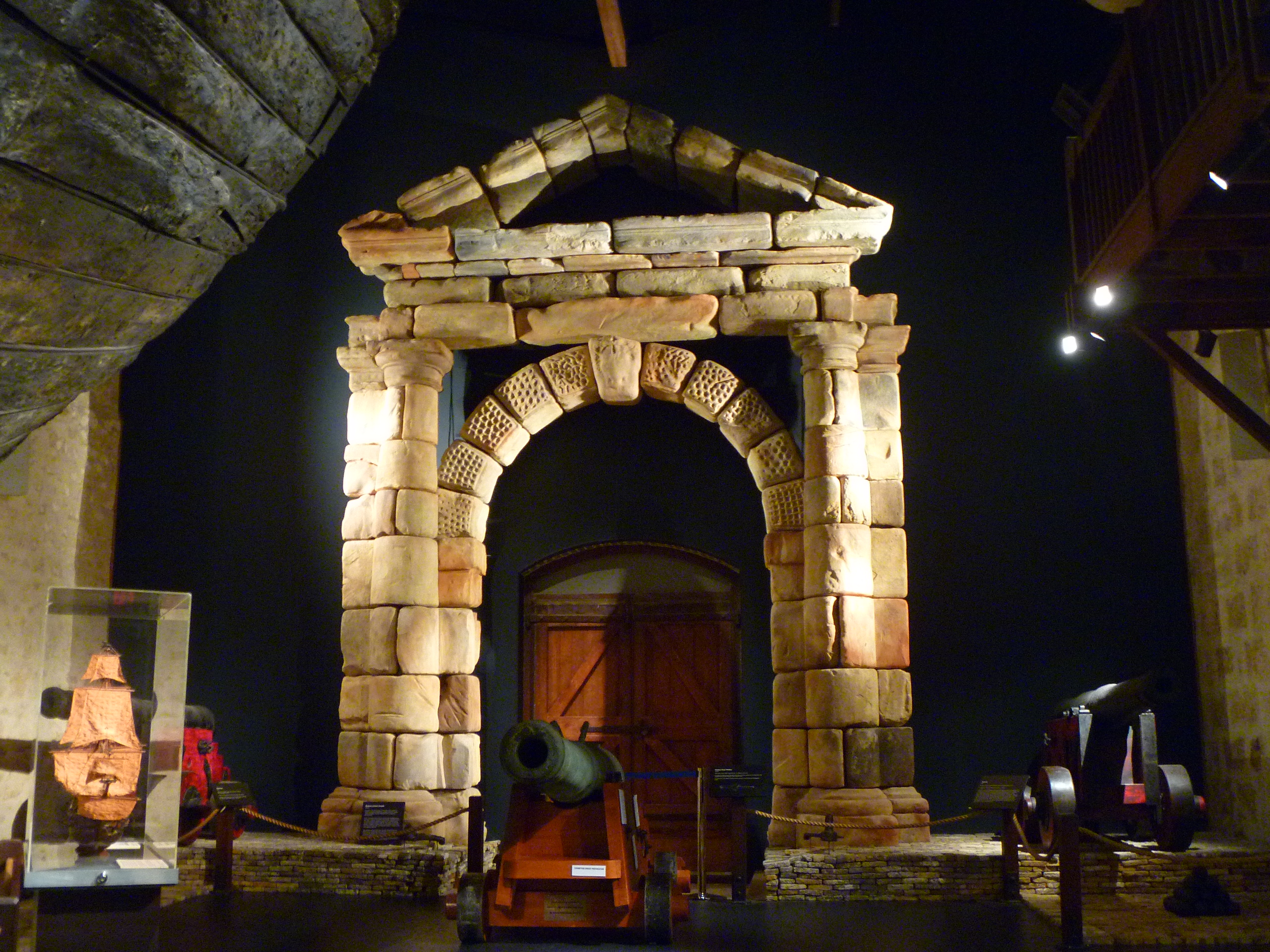
The watergate for Kasteel Batavia

The watergate for Kasteel Batavia

Regretfully the Kasteel Batavia no longer exists as it was demolished by the Dutch Colonial Government and its building materials recycled to build the former Fort Cornelis in the Jatinegara area of present day Jakarta.

ianburnetbooks.com
Posted in Uncategorized | Tagged , , , , , | Leave a comment

The Walls of Old Batavia

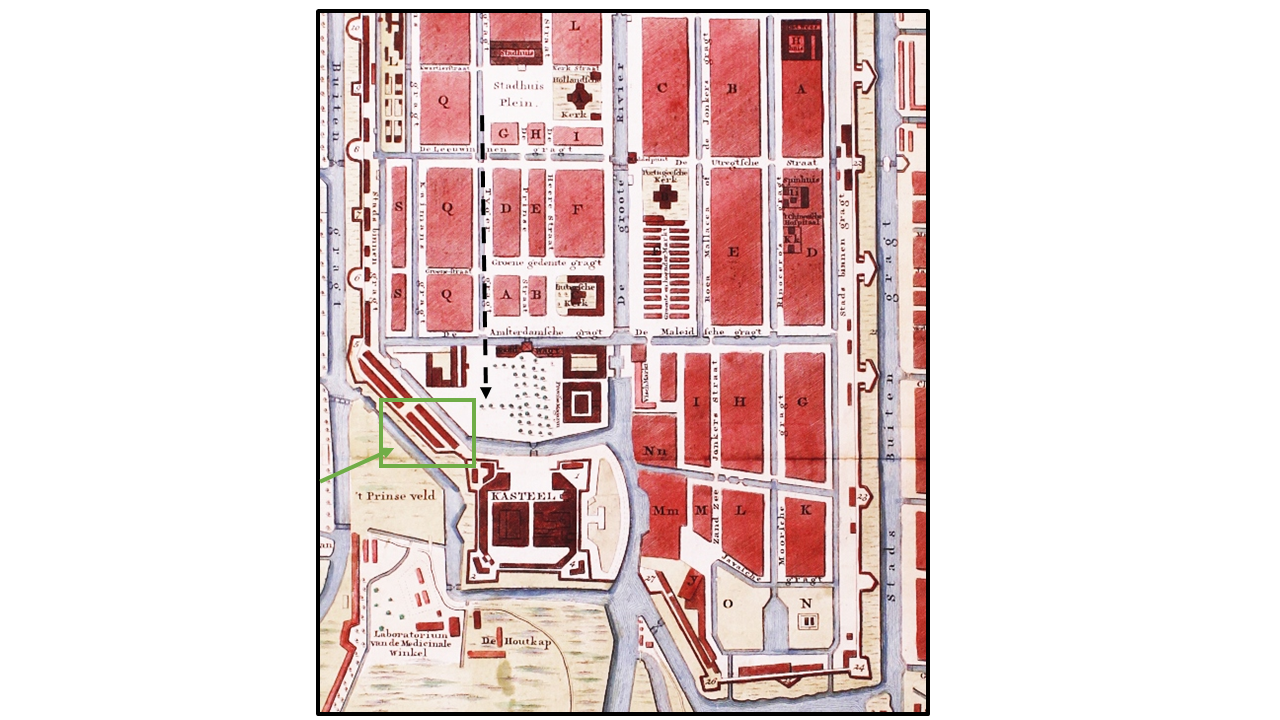
The map below shows the outline of the City of Batavia and its defensive walls and bastions in 1780, at the peak of its commercial development and before the subsequent bankruptcy of the United Dutch East India Company (VOC) only another 15 years later.

The walled city of Old Batavia

The walled city of Old Batavia

Who would believe that after more than 300 years some of the walls of Old Batavia are still standing? Along with Sake Santema from the Bartele Gallery and a small group of enthusiasts we decided to mount an expedition to ‘discover’ part of the old wall. Walking north from Fatahillah Square along Jalan Pintu Besar Utara we passed under the tollroad and then turned right across a muddy open area used to store construction materials. The detail map shows the location of the remaining warehouse and the old wall.

Map of Batavia. Detail

Map of Batavia. Detail

The map shows four warehouses originally built in this location but only one is remaining. These warehouses were built by the VOC from 1700 to 1752 in the eastern area between the City of Batavia and Kasteel Batavia. Known as the Graanpakhuizen (grainwarehouses) they were used to store corn, rice, beans, peanuts, peas, ships biscuit and other foodstuffs. It is possible to enter the abandoned warehouse and after you pick your way throught the dust, dirt and debris you can admire the massive teak beams used in its construction. There must be a way to preserve this historic building before it is allowed to be destroyed by the onslaught of ‘development’.

How much longer can this historic building survive?

How much longer can this historic building survive?

On the east side of the warehouse we passed through a gap which allowed us to follow the outside of the Old Wall towards the northwest. Here there is a pathway between the wall and the temporary houses built along the canal which extended towards Kasteel Batavia before it was demolished by Marshall Daendels in 1809 to build Fort Cornelis.

The old wall and local residents

The old wall and local residents

This photograph show our small group standing in front of the old wall which towers above us. Sake Santema is holding the historic map of Batavia that we used as our guide.

A remaining part of the old walls of Batavia

A remaining part of the old walls of Batavia


http://www.ianburnetbooks.com

Posted in Uncategorized | Tagged , , , , , | 12 Comments

Fort Nieuw Victoria, Ambon — A Mystery Solved?

A fort on this location was built by the Portuguese in the 1500’s and then captured by the first war fleet commissioned by the United Dutch East India Company in 1605 and commanded by Steven van de Hagen. The fort was the first permanent settlement of the VOC in the East Indies and the first three Governor’s-General of the VOC were based here, prior to the establishment of Batavia in 1619.

Fort Nieuw Victoria 1755

Fort Nieuw Victoria 1755

The first Governor-General was Frederick de Houtman from 1605-1611, who happened to speak fluent Malay as a result of his eighteen month imprisonment by the Sultan of Aceh. A painting of Ambon and a greatly exaggerated Fort Victoria hangs in the Rijksmuseum in Amsterdam with an adjacent cartouche showing an image of Frederick de Houtman. The cartouche that is painted out is where Frederick de Houtman apparently claimed credit for the capture of the fort, credit which belonged to Steven van de Hagen.

Fort Victoria

Fort Victoria

The fort was severely damaged by an earthquake in 1754 and rebuilt as Fort Nieuw Victoria. Ambon and its surrounding islands became more important to the VOC as it was here that they concentrated their clove plantations so as to control and monopolize the production of cloves from the Moluccas.
Fort Nieuw Victoria is still a military base so there is no public access and even photography of the outside of the fort is forbidden. When I visited I was able to see a very impressive changing of the guard ceremony (no photographs allowed) and tried to convince the guard on duty if I could take a photograph of the historic entrance, no success until one of the commanding officers came along and said “ok, let that crazy foreigner take his photo, but remember only the entrance”.

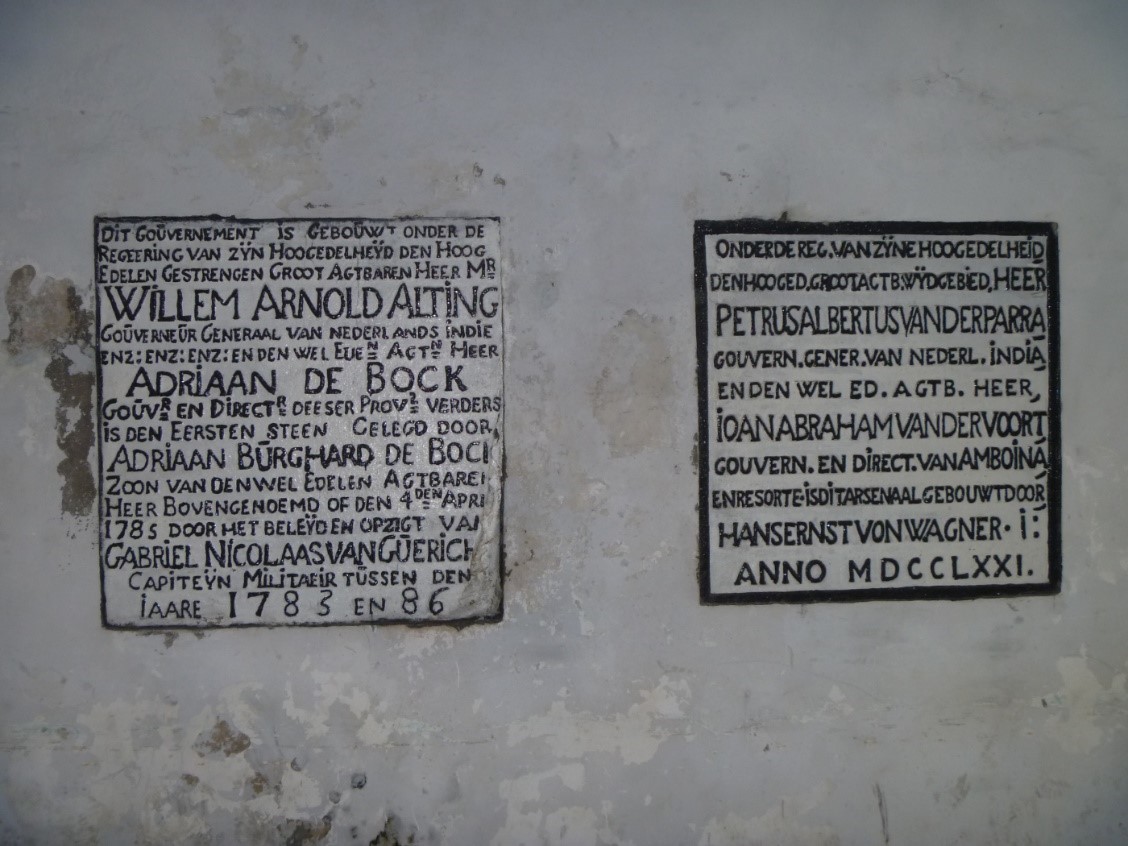
Each of the bastions is named and on exploring the outer walls I found Groeningen and Hollandia but could not get access to the others. Near the northwest bastion I found a plaque with the words Adriana Iohanna (Johanna?) which I assumed to be a name or names, and I was curious as to its significance.

P1020006

Could this be Adriana de Stuers-de Kock? Her father headed the Dutch contingents that fought against Diponegoros’ armies in the ‘Java Wars’. Adriana was born in Surabaja in 1809, grew up in Batavia, and married her father’s adjudant in 1828. In 1837 her husband was appointed governor of the Moluccas. Unfortunately the ship carrying the new governor and his family founded on a coral reef on route to Ambon. Here the 140 passengers and crew including Adriana, who was now expecting her fifth child, managed to survive by clinging to the reef and the wreck. After four weeks of this ordeal they were finally rescued and brought to Ambon.

Is this the same Adriana on the plaque or somebody else? My thanks to Abe Smits a voyager on our 2014 Spice Routes/Spice Wars sailing adventure who brought the name of Adriana Johanna Bake to my attention.

It now seems more likely that the plaque is for Adriana Johanna Bake who was born in Ambon in 1724 and married in 1743 in Batavia to Petrus Albertus van Parra who became Governor-General of the East Indies in 1761, and for whom an inscription is seen on the entrance to the fort.

Van Parra


ianburnetbooks.com

Posted in Uncategorized | Tagged , , , , , , , | 3 Comments

The Coronation of the Sultan of Tidore — October 2014

The Coronation of the Sultan of Tidore

The Coronation of the Sultan of Tidore

When our first Spice Islands Sailing Adventure reached Tidore in 2012 we sadly learnt that the Sultan had recently passed away. During that visit we were taken to a Council House high on the mountain, where the elders would meet to decide which one of the Sultan’s heirs would become the new Sultan. When we returned in 2013 there was still no new Sultan. However our visit in 2014 just preceded the official Coronation of the new Sultan of Tidore. One of our voyagers, Randall Rutledge, stayed on to view the proceedings and our thanks go to Randall for the following account and photos of the event:

One does not normally think about monarchy in relation to the unitary Republic of Indonesia, but monarchies do indeed exist within the confines of the republic. One such polity is the Sultanate of Tidore located in the Province of Maluku in eastern Indonesia. On October 22 this year, the 37th Sultan of Tidore, Husain Syah, was enthroned in a ceremony held at the newly restored palace (istana) in the royal capital town of Soasiu. I was fortunate enough to secure an invitation, along with eight other foreigners, to attend the ceremony.

Preparations at the Sultan's Palace

Preparations at the Sultan’s Palace

Starting at around 8:00am, the thousands of invited guests, ranging from local citizens to representatives of the republican, provincial and regency governments, to members of the ulama and representatives of other traditional monarchies, started to arrive. We were all seated beneath enormous tents arrayed around the periphery of the palace grounds. All attendees were required to dress in traditional clothes. I certainly stood out in my poorly fitting borrowed outfit, but the locals seemed to appreciate and enjoy the fact that we made the effort.

Much to our surprise, and slight embarrassment, our group of nine was ushered to front row seats in one of the tents facing the royal dais in front of the Istana’s grand dual staircase. From this vantage point we were able to take in all of the festivities. The actual coronation of the Sultan with the crown (mahkota) of Tidore took place out of sight of the gathered guests within the palace itself. The ceremony was described to those outside the palace over a public announcement system in three languages: Bahasa Tidore, Bahasa Indonesia and English. After the coronation, the Sultan, wearing the mahkota, which is made of gold and human hair, made an appearance on the second floor balcony of the palace giving all of those in attendance an opportunity to see him in his regalia.

Soon after, about twenty cars and vans drove into the Istana grounds with government officials and representatives of other traditional monarchies, who proceeded into the Istana to offer their congratulations to the Sultan and his wife. After lunch was served the the Sultan rose from his throne and delivered a speech in Bahasa Indonesia, to the gathered multitudes.

The Sultan of Tidore and his wife

The Sultan of Tidore and his wife

Once he concluded all of the guests were invited to come to the dais and greet and congratulate the new sultan and his wife (who has the title of Boki). And they all did! The event took on a festive air at this point as thousands of people queued up to shake hands with both the Sultan and his wife. The Sultan sent one of his aides to ask our group to wait till the end so that we could pose for photos with the royal couple. In the meantime while we waited we must have been photographed by everyone with a camera. Foreigners apparently aren’t that common on Tidore, especially a group of such motley dressed ones. I couldn’t tell if they were laughing with us or at us. But it was fun none the less. By now it was close to 2:00 as we were escorted onto the stage to greet the Sultan who welcomed us in English and gladly posed for photographs with all of our group. We then took our leave and returned to our hotel on the neighboring island of Ternate; exhausted from the heat, but excited about the rare event we had been fortunate to witness.

Randall Rutledge with the Sultan and his wife

Randall Rutledge with the Sultan and his wife


ianburnetbooks.com

Posted in Uncategorized | Tagged , , , , , , | Leave a comment

The Forgotten Founder of Singapore

I have always been surprised by the lack of recognition in Singapore for its co-founder William Farquhar. Please correct me if I am wrong but I cannot find a street or place named after him anywhere in the city.

William Farquhar Image 3

In 1818 the Governor-General of India authorized Stamford Raffles to establish a post at the southern end of the Strait of Malacca provided it did not cause a conflict with the Dutch and his orders stated:

The long experience and peculiar qualifications of Major Farquhar, the late resident of Malacca, and his late employment at Riau and Lingga, eminently fit him for the command of the post which it is desirable to establish, and the local superintendence of our interest and affairs.

While the British Resident in Malacca from 1803 to 1818, William Farquhar had established friendly relations with the Temenggong Abdu’r-Rahman of Johor. Knowing that the Dutch would soon be returning to the Strait of Malacca after the hand-over of Java and its dependencies by the British in 1816, he concluded an agreement with the Temenggong (A Malay Chief) allowing the British to establish a settlement in the Riau Islands. Subsequently the Dutch had installed their Resident in the Riau Islands and forced the Temenggong to annul the agreement with Farqhuar.
It was Raffles and Farquhar who landed together at the Singapore River on 29 January 1819. The Temenggong who lived nearby came out to welcome his old friend William Farquhar. Introduced to Raffles, he told them of the current dispute within the Johor-Riau Sultanate. In 1810 the Sultan of Johor had died, his eldest son Tengku Long was his successor; however, the powerful Bugis faction in the Johor-Riau court exploited Tengku Long’s absence at his own wedding to declare his more compliant younger brother as Sultan.

Raffles took advantage of this dispute to sign an agreement on 6 February 1819 with ‘the legitimate successor to the empire of Johor’ for the British to set up a trading settlement on part of Singapore Island and his official Proclamation reads:

The Honourable Sir T.S.Raffles, Lieutenant-Governor of Bencoolen and its dependencies, Agent to the Governor-General is pleased to to certify the appointment by the Supreme Government of Major William Farqhuar of the Madras Engineers to be Resident and to command the troops of Singapore and its dependencies and all persons are hereby directed to obey Major Farquhar accordingly.

Farquhar with his long experience in Malacca was an effective Resident of Singapore for the next four years until churlishly dismissed by Raffles on 1 May 1823, just before his term was about to end.

William Farquhar Book

During his twenty years in Malacca and Singapore, William Farquhar amassed a unique collection of 477 paintings of native flora and fauna especially commissioned from local artists. The William Farquhar Collection of Natural History Drawings was presented to the Royal Asiatic Society London in 1827 where it remained until put up for auction in the 1990’s. Thanks to the generosity of Goh Geok Khim, founder of the brokerage firm GK Goh, the collection was purchased for S$3 million in 1995 and donated to the Singapore History Museum in honor of his father. The William Farquhar Natural History Collection is now listed as one of the National Treasures of Singapore.

William Farquhar.Collection

For those interested in knowing more about the founding of Singapore, the book or e-book of East Indies is available on order from your favourite bookstore, or the usual online retailers.


ianburnetbooks.com

Posted in Uncategorized | Tagged , , , , , | Leave a comment

The Ambon War Cemetery

AustraliaLargeFlag

They shall grow not old as we that are left grow old, age shall not weary them nor the years condemn, at the going down of the sun and in the morning we will remember them.

051

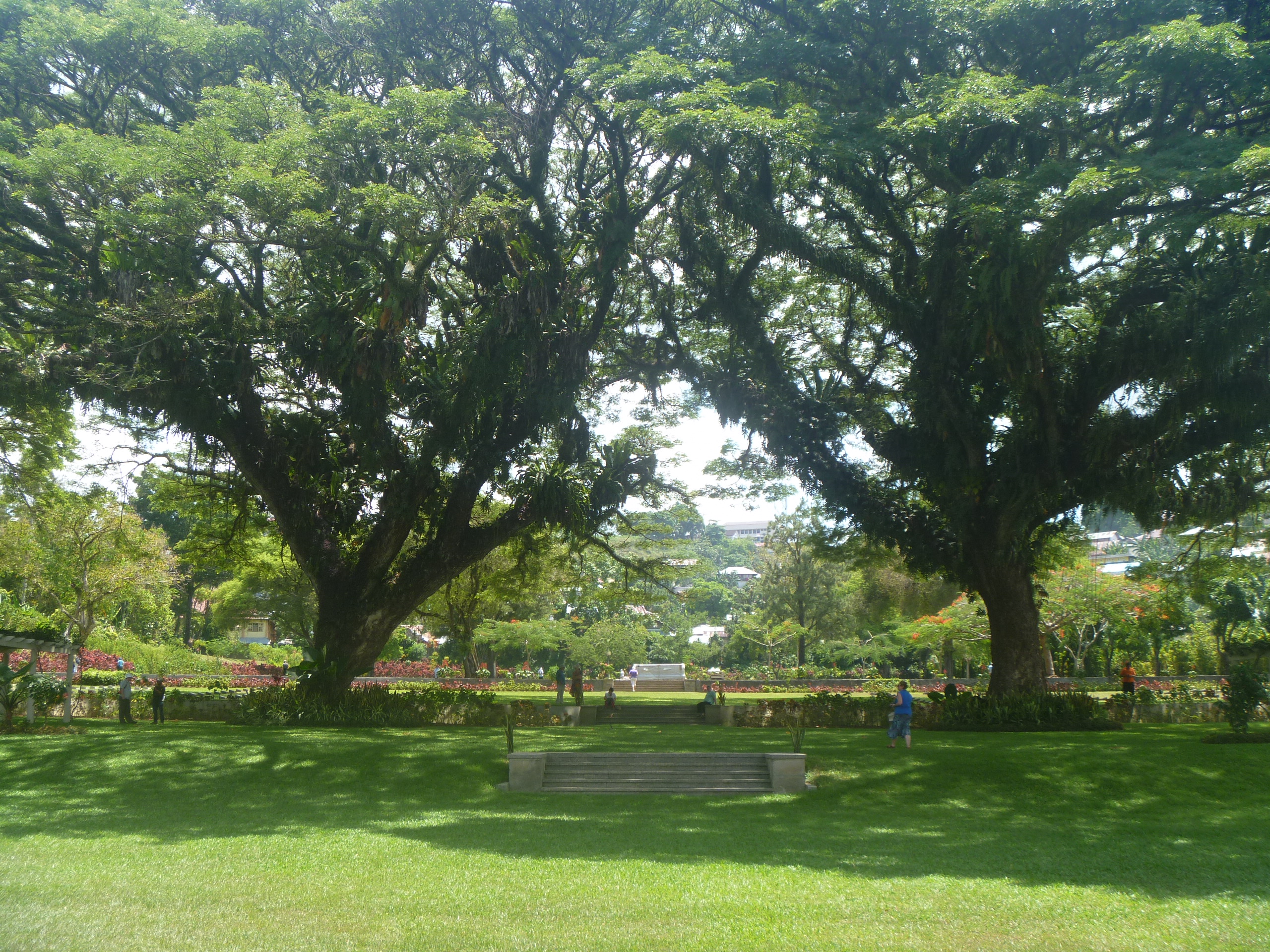
The Commonwealth Graves Cemetary in Ambon is green oasis in the busy town of Ambon, carefully maintained in honour of our fallen soldiers, sailors and airmen, a visit here is a deeply moving experience.

After the fall of Ambon in February 1942, a former Dutch army camp on the island was used to hold Australian, American and Dutch prisoners of war, captured during the invasion. The recently published book Ambon by Roger Maynard tells the story of the Australian 2/21 Battalion known as Gull Force sent to defend Ambon from the expected Japanese invasion. This Japanese prisoner of war camp had the highest death rate of any similar camp during the war. With food reduced to starvation levels combined with forced labour, the death toll soared in 1945. By the time of the Japanese capitulation only 123 of the 532 Australians left on Ambon in late 1942 remained alive. It was one of the highest death tolls that Australians experienced in captivity and many of these survivors would continue to suffer the effects of their long ordeal.

Private Leo Ayres

Private Leo Ayres

The Gull Force Associaton conducts a pilgrimage to Ambon every year to coincide with Anzac Day, where a service is held at the Tantui War Cemetery with full military support.

GullForcememorial Tantui

The War Cemetery was constructed on the site of this camp (known as Tantui) after the war. The cemetery contains Australian soldiers who died during the Japanese invasion of Ambon and Timor, plus those who died in captivity in one of the many camps constructed by the Japanese on the Moluccas Islands, including many British prisoners who were transferred from Java to the islands in April 1943. Soon after the war, the remains of prisoners of war from Haruku and other camps on the island were removed to Ambon and in 1961, at the request of the Indonesian Government, the remains of 503 graves in Makassar War Cemetery on the island of Celebes were added to the cemetery.

Ambongrave stone

The total number of graves in the cemetery is over 2,000. Of this total over half are Australians, of whom about 350 belonged to the 2/21st Australian Infantry Battalion. Most of the 800 British casualties belonged to the Royal Navy and Royal Air Force; nearly all the naval dead were originally buried at Makassar. The cemetery is laid out in a series of terraces approached by short flights of steps on the central axis. The Ambon Memorial, which is in the form of a shelter, stands on the first terrace. It commemorates over 450 Australian soldiers and airmen who died in the region of Celebes and the Molucca Islands and have no known grave. The Cross of Sacrifice stands on the highest terrace in a wide expanse of lawn; the terrace below it contains most of the burials from Makassar. All the graves are marked with bronze plaques mounted on concrete pedestals and set in level turf. Tropical trees and shrubs are planted throughout the cemetery and around its boundaries. There are 1,956 Commonwealth burials of the 1939-1945 war here,357 of these are unidentified. There are 186 Dutch burials here, 15 being unidentified, and 1 American Airman. The American airman was killed with 7 Australian airmen in July 1945; all were buried in a collective grave in Plot 28.


ianburnetbooks.com

Posted in Uncategorized | Tagged , , , , | 17 Comments

The Ambon War Cemetery – Damien Parer

AmbonFlag

They shall grow not old as we that are left grow old, age shall not weary them nor the years condemn, at the going down of the sun and in the morning we will remember them.

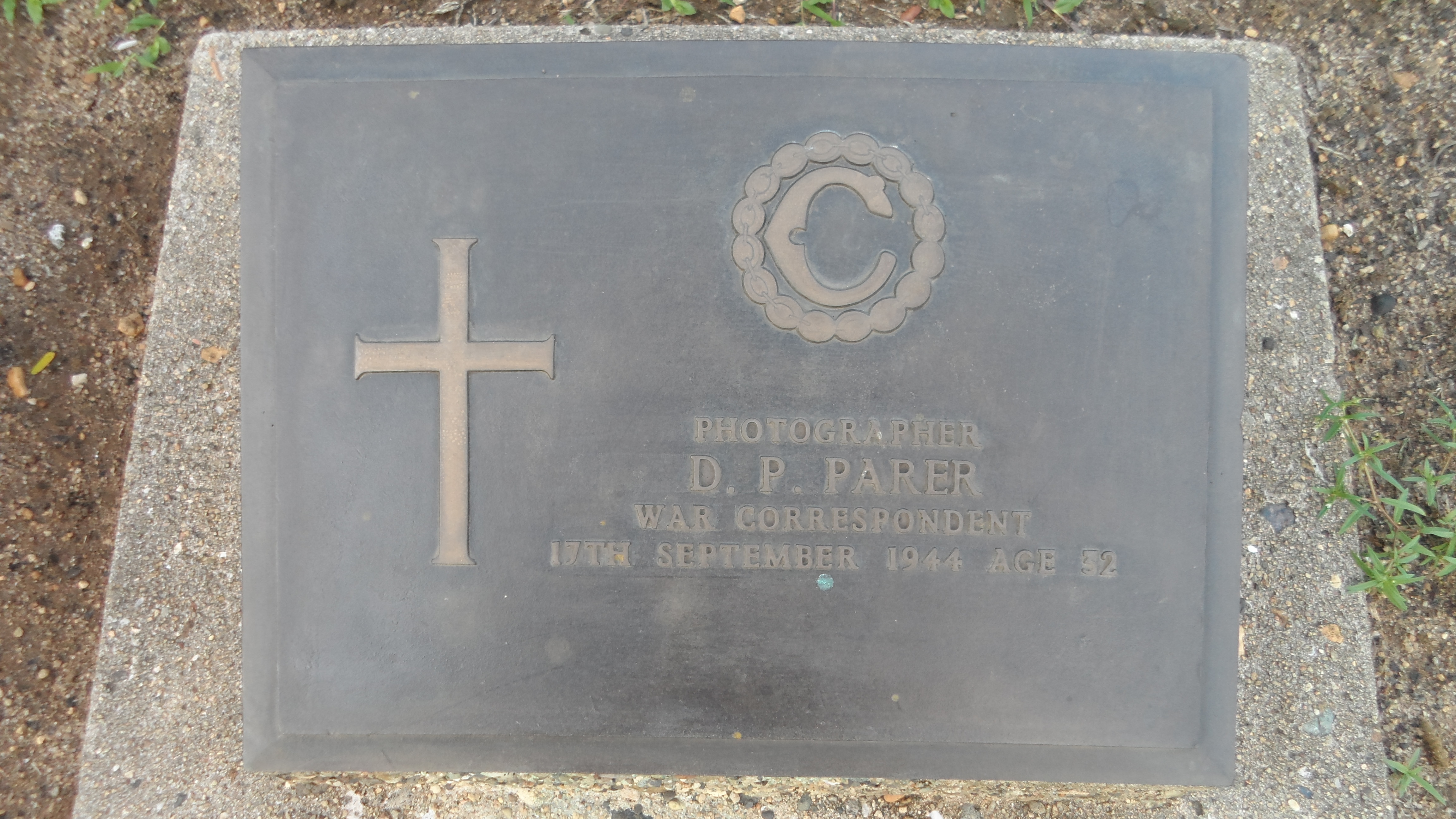
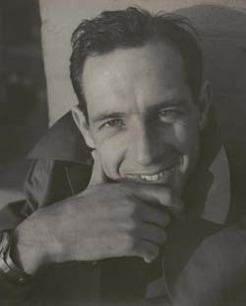
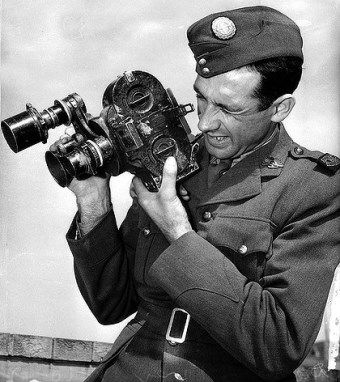
The famous Australian war photographer, Damien Parer, was killed on the afternoon of 17 December 1944 by Japanese machine-gun fire, while walking backwards and filming the faces of advancing American marines on the small Pacific island of Peleliu. He was subsequently buried in the Commonwealth War Graves Cemetary in Ambon where we found his gravestone. Parer’s short life was the stuff of legend. He was good looking, talented, fearless and deeply religious. With an infectious laugh, he was everybody’s friend.

Damien Parer 3

Parer was the first official Australian photographer of World War II. In January 1940 he sailed for the Middle East with elements of the Australian Imperial Force. From the gunboat, H.M.S. Ladybird, he filmed the bombardment of Bardia, Libya, on 2 January 1941. With Frank Hurley, he covered the Australian assault on Tobruk on 21-22 January. Three days later he accompanied ‘C’ Company, 2nd/11th Battalion, in its attack on the aerodrome at Derna, and shot his first film of infantry advancing under fire. His work was seen in war newsreels and his name became well known across Australia.

When Japan entered World War II Parer returned to Australia. After covering operations with Kanga Force around Wau and Salamaua, New Guinea, in 1942-43, he filmed the Australian withdrawal along the Kokoda Track in Papua. On 18 September Cinesound Productions Ltd released the newsreel, ‘Kokoda Front Line’, which used his footage. This film was one of four films that won the inaugural award for Best Documentary at the 1943 Academy Awards and an Oscar was presented to its producer, Ken Hall, ‘for distinctive achievement in documentary production’.

Damian Parer 1

In 1943 Parer’s footage was used in the Cinesound newsreels, Men of Timor, The Bismarck Convoy Smashed and—arguably his finest work—Assault on Salamaua. Disgruntled with his salary and allowances, and convinced that the Department of Information had victimized his colleagues George Silk and Alan Anderson, he resigned in August and joined Paramount News. Thereafter he covered American operations. On 17 September 1944, the second day of the invasion of Peleliu Island in the Palau group, Parer was killed by a Japanese machine-gunner and was subsequently buried in the Ambon war cemetery.

Lest we forget

Damien Parer


ianburnetbooks.com
Posted in Uncategorized | Tagged , , , , , , | 2 Comments

Taking a Taste of the Archipelago

2015 logo

Archipelago Panel

By Phil Kimmins

“Get out there. Get on a boat, a plane, and go visit Indonesia, because you’ll find the most extraordinary food.”

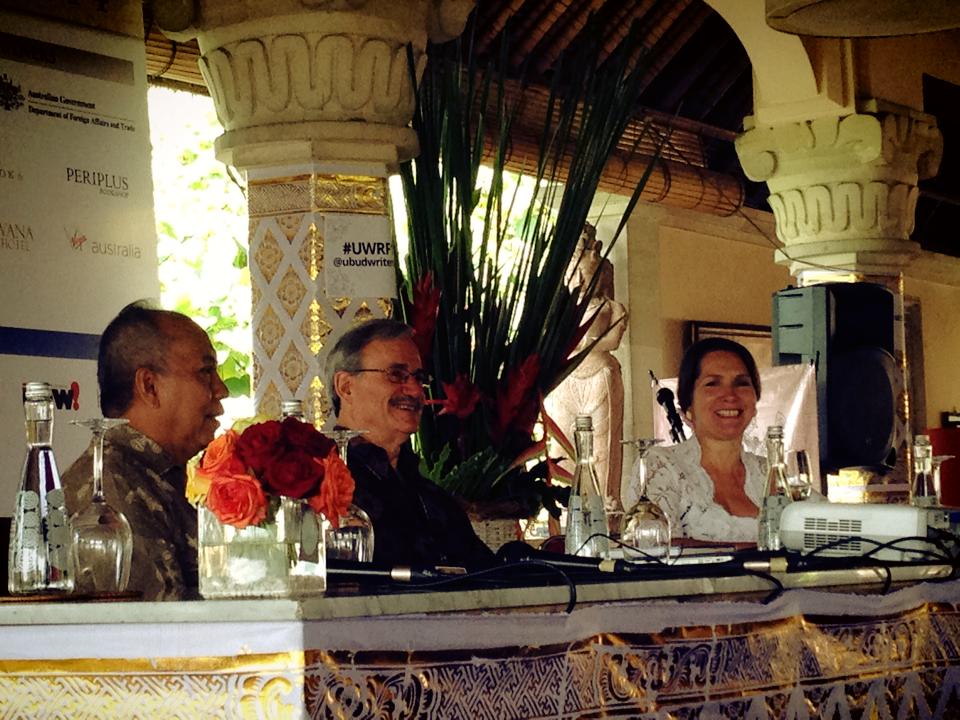
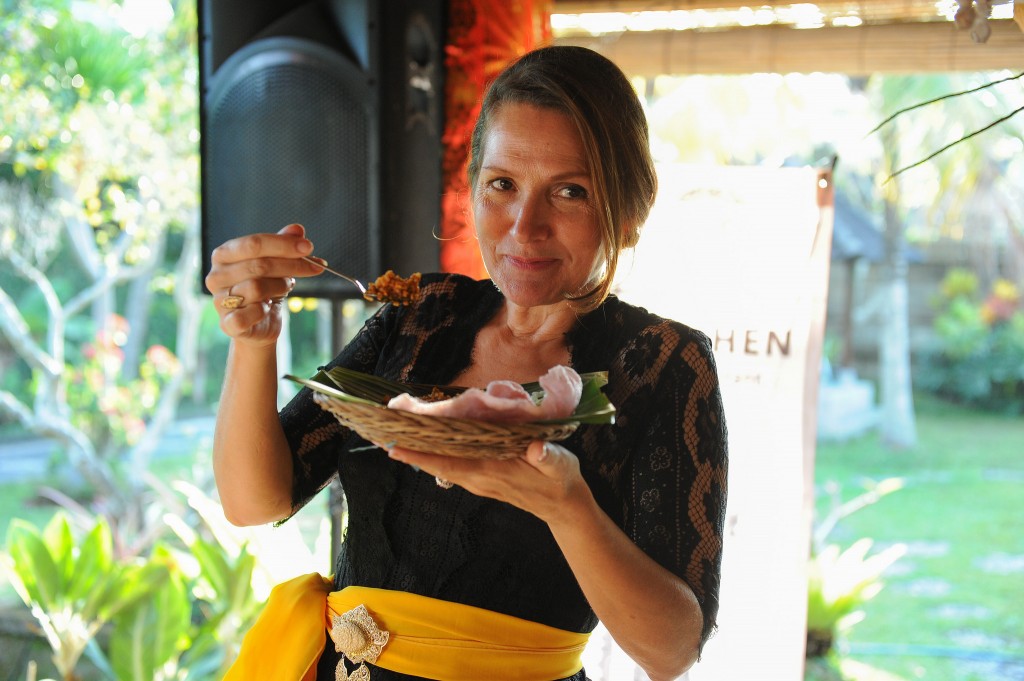
This was the advice of Ubud Writers & Readers Festival (UWRF) Founder & Director Janet de Neefe, hosting a fascinating panel session on Sunday 5 October. Visitors were treated to an informative and humorous look at the diverse range of foods and spices of the Indonesian archipelago, The Spice Islands.

Panellists Bondan Winarno, legendary East Javanese cook featured on Saturday’s Kitchen Program, and Ian Burnet, “a man who knows his nutmeg,” provided a highlight for foodies. Bondan enchanted the audience with anecdotes and his in-depth knowledge of the origins and histories of all things culinary within Indonesia.

Ian Burnet, who moved from Australia to Indonesia in 1968, delved into the history of the Spice Islands and fascinated guests with some bizarre recipes popular in the 17th century. Ian hosts sailing ventures that roam the archipelago on voyages of culinary discovery.

An entertaining session concluded with Janet reminding visitors of her dream of a food festival for next year and what the cuisine of Indonesia means to her.

“I never stop being curious about Indonesian food and I love these sorts of sessions, especially with Bondan Winarno, because he is so knowledgeable, and Ian Burnet’s great knowledge of spices. The little pearls of wisdom and wonderful anecdotes are a joy.”

uwrf_taste_archipelago_giv

About Global Indonesian Voices
Global Indonesian Voices (GIV) is Indonesia’s first independent online media, established for ‘Connecting Indonesia to the World‘ by publishing independent news and stories written by and for Indonesians and Indonesia-philes all around the world.

Posted in janet de neefe | Tagged , , , , | Leave a comment

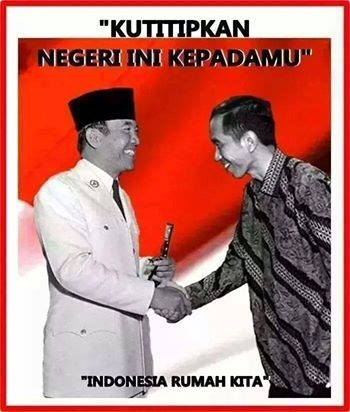
Congratulations President Joko Widodo

SoekarnoJokowi

Posted in Uncategorized | Leave a comment

Operation Opossum — The Rescue of the Sultan of Ternate, 1945

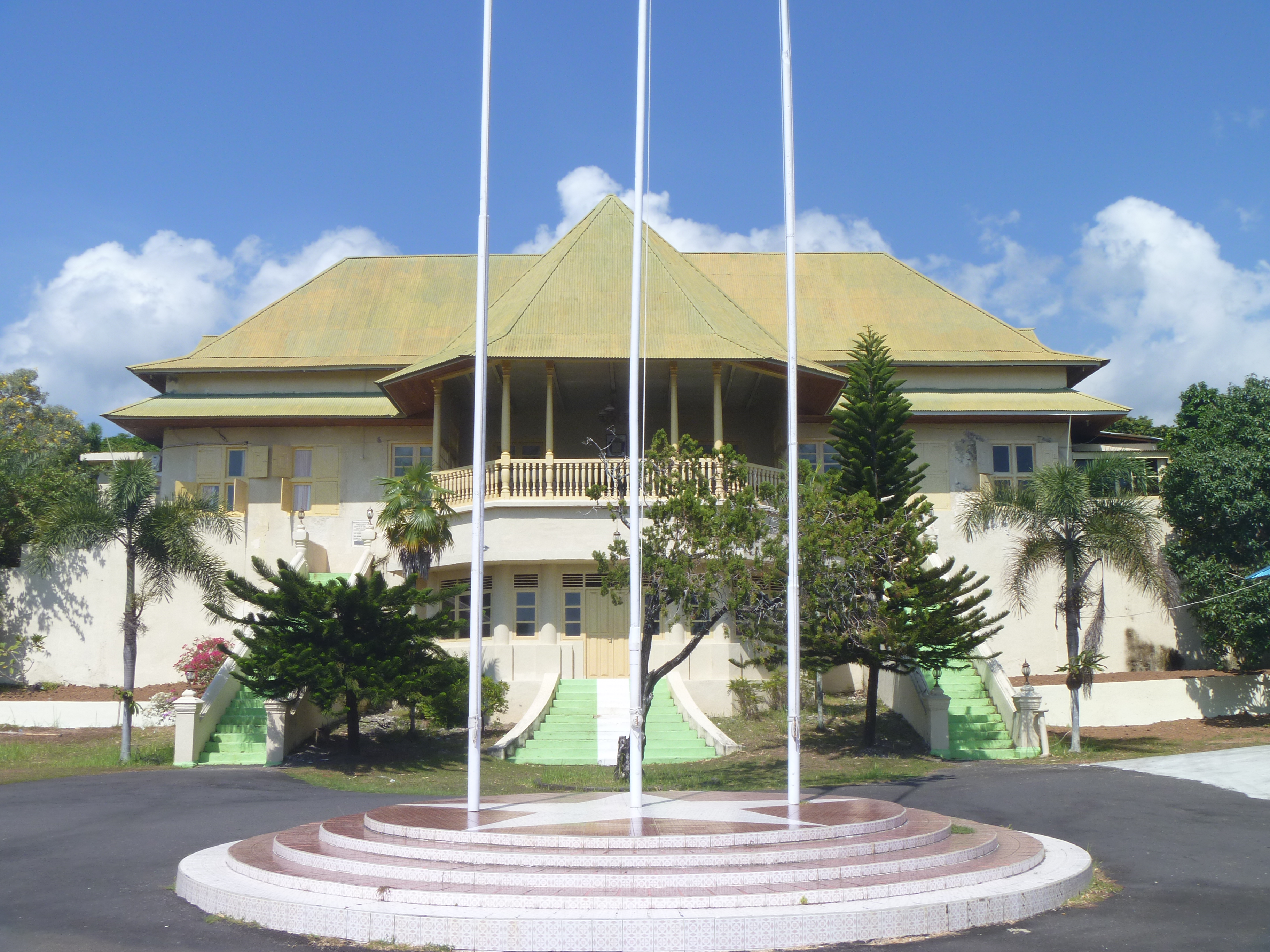
The Sultan's Palace in Ternate

The Sultan’s Palace in Ternate

On our visit to the Sultan’s Palace in Ternate we learned of how the family was rescued from the Japanese at the end of the Second World War. Here are the details summarised from an article by Kevin Smith in Sabretache, Vol LIII No 4 — December 2012 (The Journal of the Military Historical Society of Australia) and provided by Kevin O’Donnell whose father, Signaller Walter O’Donnell, was the radio operator for Z Special Unit

Sultan Muzaffar Syah who was evacuated to Australia as a small boy

Sultan Muzaffar Syah who was evacuated to Australia as a small boy

An Australian Z Special Unit was formed in 1945 to extract the Sultan of Ternate with his immediate family and followers from Japanese detention on Ternate. Sultan Iskander Mohammed Jabir Shah under Japanese domination on Ternate since its capture in 1942 had become fearful for his personal safety and that of his family. He secretly sent several of his followers in a prahu to the AIF Headquarters on Morotai, about 200 kilometres to the north-east of Ternate to appeal for rescue.

Ten Australian Z Special Unit commandos were led by Captain Kroll of the Netherlands East Indies Army and joined by a Timorese Corporal from the NEIA.The raiding party left Morotai on two American fast PT boats and landed on Hiri island, just north of Ternate on 8 April 1945. A messanger was immediately sent to the Sultan who was detained in a house on the upper slopes of Mount Gammalama. On receiving the message written in Dutch by Captain Kroll, the Sultan replied that he would try to come out but was surrounded by traitors.
Z Special Unit sent five large native prahus with a loyal crew to a pre-arranged pick up point at the village of Kubala on Ternate. Sultan Iskander Shah and his family managed to elude his captors and walked six hours during the night to reach the village.

The Sultan’s landing on Hiri on April 10 was described by Major Hardwick as “One of the most dramatic scenes I have witnessed in these lands”. The Ternate Sultanate provided a line of Islamic rulers going back for eight centuries and there was great excitement on Hiri as word spread from one loyal kampong to the next that their Sultan was free. Elders came forward to kiss his feet and all his subjects squatted briefly on one knee with their hands pressed to their faces in a traditional gesture of loyal homage. Hardwick found the Sultan to be a man of considerable culture who could speak French, English and Dutch and he describes a local bodygard, dressed in white and armed with parangs, who protected the Sultan and his family while they rested overnight.

Having learnt of the Sultan’s escape a Japanese landing party crossed over from Ternate at dawn the following day, resulting in a firefight which caused Japanese deaths and their withdrawal, but at the cost of two of the lives of the Australian commando force — Lieutenant George Bosworth the Commando Leader and Private Robert Higginbotham.
That same day they all left on the PT boats for Morotai and the Sultan and his family were flown by Catalina flying boat to Brisbane in Australia where they found refuge for the remainder of the war.
Dutch plans for the Sultan to play a role in the post war Netherlands East Indies never eventuated after the declaration of Indonesia’s independence in August 1945 by President Sukarno and Vice-President Hatta, and the Indonesian resistance to the Dutch return to their former colony.

The Sultan's Family outside their Queensland home

The Sultan’s Family outside their Queensland home

The Sultan's young children in Queensland

The Sultan’s young children in Queensland


ianburnetbooks.com
Posted in Uncategorized | Tagged , , , | 5 Comments