In June 1856 the British naturalist Alfred Russel Wallace crossed the narrow strait between the islands of Bali and Lombok. During the few days when he stayed on the north coast of Bali he saw birds highly characteristic of Asian ornithology of which he was already familiar and would expect to see the same birds as soon as he crossed the Lombok Strait. After a turbulent crossing and being dumped on the shores of Lombok he never saw the same birds again. He found a totally different set of species, most of which were entirely unknown not only in Java, but also in Borneo where he had spent the last two years.
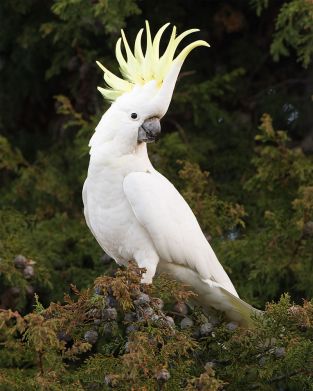
Among the commonest birds he found in Lombok were white cockatoos and honeyeaters which are characteristic of Australia and are entirely absent from the western region of the archipelago.
Wallace wrote in his book The Malay Archipelago:
The great contrast between the two divisions of the Archipelago is nowhere so abruptly exhibited as on passing from the island of Bali to that of Lombok, where the two regions are in closest proximity … The strait is here fifteen miles wide, so that we may pass in two hours from one great division of the earth to another, differing as essentially in their animal life as Europe does from America.
The Lombok Strait represents part of the biogeographical boundary between the fauna of Asia and those of Australasia which was subsequently named the Wallace Line. On the Asian side of the Wallace Line are the Asian elephant, the rare Javanese rhinoceros, Sumatran tigers and Borneo leopards, all kinds of monkeys, the orang-utans of Sumatra and Borneo, and numerous birds that are specific to Asia. On the Australasian side are the marsupials such as the possum-like cuscus and the tree kangaroos, as well as birds specific to Australasia such as white cockatoos, honeyeaters, brush turkeys and the spectacular Birds of Paradise. By his observations Alfred Russel Wallace had made a major contribution to a new science, the science of biogeography, or of the relationship between zoology and geography.
That larrikan of the Australian bush, the yellow crested white cockatoo, made his presence felt all across Wallacea which is the name given to that part of the eastern archipelago which has Australian species.
Here he has pushed himself into an Indonesian market scene, which a Dutch artist has used to display the many varieties of tropical fruits found in Indonesia.
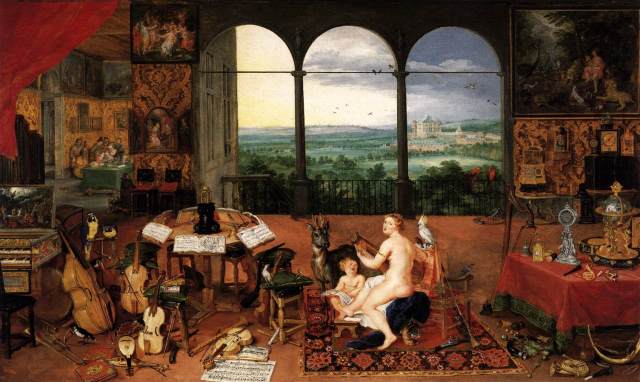
He also hitched a ride on a EastIndiaman to travel to Holland where he has pushed himself into a ladies boudoir in this allegorical scene by Jan Brueghel. Of course he will soon spoil this scene of happy domesticity by screeching the only sound he knows.
The Sense of Hearing by Jan Brueghel
Read more about the voyages of Alfred Russel Wallace, the Wallace Line and Wallacea in this recently published book entitled ‘Where Australia Collides with Asia.
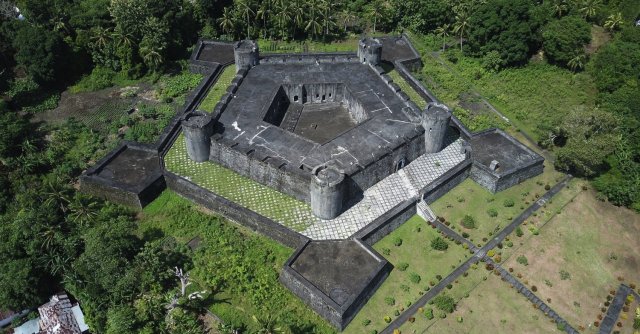
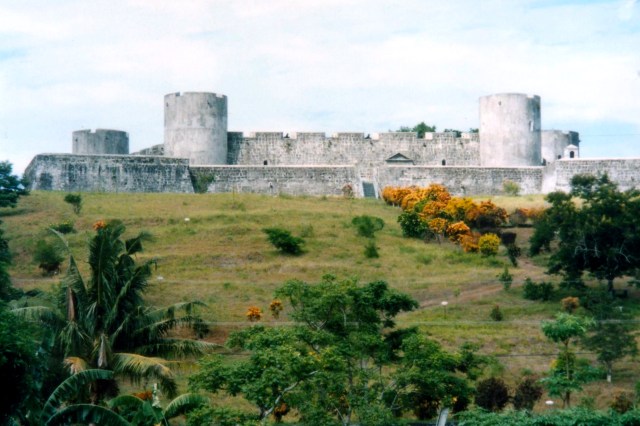
The original Fort Belgica was rebuilt in 1673 and the new design consisted of a low outer pentagonal structure with five angled corner bastions and a higher inner pentagon with five tall circular towers. The fort was built by the Dutch East India Company (VOC) to protect their monopoly of the nutmeg trade from the Banda Islands and particularly by attack from the English East India Company.
The original plans for the new fort drawn in 1667.
An arial photo showing the outline of Fort Belgica today.
Drone photograph by Alexandre Giradeau
Notwithstanding its massive design, an armanent of 50 cannon and a garrison of 400 men, the fort was captured twice by the English. Once in 1796 when it surrended to an English fleet without a shot being fired and once in 1810 when the fort was captured by British marines led by Captain Christopher Cole. As he described the attack:
The gallantry and activity with which the scaling ladders were hauled up after the out-work was carried and placed for an attack on the inner-work, under sharp fire from the garrison exceed all praise. The enemy, after firing their guns and keeping up an ineffectual discharge of musquetry for ten or fifteen minutes, fled in all directions through the gateway, leaving the Colonel-Commandant and ten others dead, and two officers and 30 prisoners in our hands.
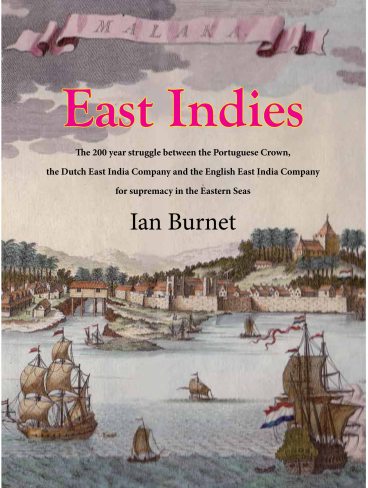
(Extract from the book East Indies by Ian Burnet)
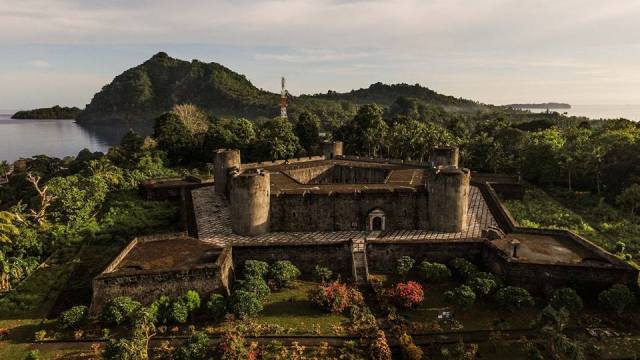
The commanding position of Fort Belgica can be seen from this drone photograph.
Drone photo courtesy of the Nutmeg Tree Hotel
The massive walls of the fort seen from the ground.
It is a great location to entertain visitors with cultural dances and here are the nutmeg girls resting on the ramparts of Fort Belgica.
And it is a great location to take sunset photographs.
From humble beginnings in 2002, the Ubud Writers & Readers Festival has evolved into one of the world’s most celebrated literary and artistic events – an annual pilgrimage for lovers of literature and conversation.
Bringing together some of the world’s most powerful voices in a melting pot of artists, authors, thinkers and performers, the Festival is a platform for meaningful exchange and cross-cultural dialogue. A place where artists and audiences alike can discuss shared inspirations, ideas and concerns, the Festival transcends cultural and geographical borders to create a truly global community.
Not withstanding the rumblings of Gunung Agung, this years UWRF will be another outstanding event. Featuring writers such as Jung Cheng (Wild Swans), Robert Dessaix (Night Letters), Tim Flannery (The Future Eaters), Madelaine Thien (Do Not Say We Have Nothing), Ian Rankin (Inspector Rebus stories) and Simon Winchester (Krakatoa). Personally I will be following the adventurers such as Tim Flannery (The Future Eaters), Per Andersson (The Amazing Story Of The Man Who Cycled From India To Europe For Love), Nigel Barley (The Island of Demons), Simon Winchester (Krakatoa) and Rob Henry (the documentary As Worlds Divide).
Below are some of the ‘blurbs’ regarding my participation in the Festival:
Ian Burnet has spent 30 years living, working and traveling in Indonesia. His previousthree titles, Spice Islands, East Indies and Archipelago – A Journey Across Indonesia, reflect his fascination with the nation’s diverse history, ethnicity and cultures. His latest book, Where Australia Collides with Asia, follows the epic voyages of British naturalist Alfred Russel Wallace around the eastern archipelago.
Ian Burnet telah hidup, bekerja, dan berkeliling di Indonesia selama 30 tahun. Tiga karya Ian yang berjudul Spice Islands, East Indies dan Archipelago – A Journey Across Indonesia adalah karya-karya yang mencerminkan ketertarikannya akan beragam karakter, etnis dan budaya di Indonesia. Buku terbarunya, Where Australia Collides with Asia, mengikuti kisah perjalanan hebat dari naturalist asal Inggris Alfred Russel Wallace yang mengelilingi bagian Timur nusantara.
Taman Baca. Festival Hub, Jl. Raya Sanggingan (Google Maps)
350 years ago when nutmeg was worth more than gold, the tiny island of Run played a dramatic role in Indonesia’s colonial history when it was ‘swapped’ by the British for Manhattan. Rich in precious spices, Run and the Banda Islands were the battleground of the legendary spice trade. 350 years on, these writers share their connections to the fabled Spice Islands.
Saat buah pala lebih berharga dibandingkan emas 350 tahun yang lalu, pulau kecil Run memainkan peran penting dalam perjalanan sejarah kolonialisme di Indonesia saat pulau tersebut ditukar dengan Manhattan oleh Inggris. Kaya akan rempah-rempah, Pulau Run dan Banda merupakan ladang pertempuran dari perdagangan rempah. 350 tahun kemudian, para penulis ini bertukar pikiran dan berbagi cerita tentang keberadaan pulau rempah-rempah tersebut.
Festival Club @ Bar Luna: Where Australia Collides with Asia
Stow away on some of the most epic voyages of natural history with author and historian, Ian Burnet. Follow the fascinating footsteps of Banks, Darwin and Wallace and explore the remarkable biogeographical boundary that lies just east of Bali and separates the fauna of Asia and Australasia.
Set sail for the legendary Spice Islands over a three-course long table lunch at Casa Luna. Restaurateur and Festival Founder and Director Janet DeNeefe joins forces with culinary activist and filmmaker Rahung Nasution to evoke the extraordinary flavors and coveted ingredients that changed the course of history. Historian Ian Burnet and photographer-documentary maker Muhammad Fadli will help steer the ship.
Includes three-course long table lunch.
Berlayar ke Kepulauan Rempah-Rempah legendaris selama makan siang meja panjang tiga haluan di Casa Luna. Pendiri dan Direktur Restoran dan Festival, Janet DeNeefe akan bergabung dengan pegiat kuliner dan pembuat film, Rahung Nasution untuk membangkitkan rasa yang luar biasa dan bahan-bahan yang didambakan yang mengubah jalannya sejarah. Sejarawan Ian Burnet dan fotografer pembuat karya dokumenter Muhammad Fadli akan membantu mengarahkan sesi tersebut.
Some historical narratives can be difficult to follow when they are punctuated by countless footnotes and bibliographic references, or broken by a frequent need to delve into appendices. Ian Burnet frees his work from these impediments. By seamlessly embedding his sources he has produced an almost conversational style. The result is an erudite narrative flow, free of distractions.
Where Australia Collides with Asia chronicles the reflections and discoveries of great minds and adventurous spirits. Both Darwin and Wallace who feature read Humboldt’s Personal Narrative of Travels to the Equatorial regions of the New Continent. This work introduced the notion of a web of life where no single fact could be considered in isolation. Humboldt created a new genre in writing that eloquently described nature as part of this web of life. Ian’s book is firmly in such a tradition. It is not just a treatise on Alfred Russell Wallace any more than it is a static account of biogeography. He draws on his extensive knowledge of geology and his long engagement with the Indonesian archipelago to reveal a world shaped by tectonic dynamism producing countless variations and contrasts.
Plate movements create areas that are distinct yet often close to one another. Both the Galapagos islands and the Indonesian archipelago display such features. In these places, biogeographic contrasts and transformations are easily observed. We learn that it was the distinct differences in distribution of flora and fauna along the archipelago, abruptly changing between the islands of Bali and Lombok that so intrigued Wallace. Through his research, he established this as a biogeographic boundary between Asia and Australasia.
This work allows us to see the development of Wallace’s research to the point where he summarised all the main principles of Darwin’s ideas on species. When he received Wallace’s ‘Letter from Ternate’, in 1858, Darwin’s surprise was such that he was prompted to write: ‘I never saw a more striking coincidence, if Wallace had my manuscript sketch written out in 1842, he could not have made a better short abstract.’
Darwin’s fear of challenging the literalist account of creation in Genesis certainly placed a break on this desire to publish. Wallace’s work pressed him to finally publish in 1859. All of this is and the warm friendship that developed between the two men is well covered, so too is their subsequent collaboration.
The selection of photographs, maps and illustration in this publication not only add graphical power to the work but also display Ian Burnet’s meticulous patient gathering of archival material.
In 1699 the population of Batavia consisted of 3679 Chinese, 2407 Mardjikers or Portuguese Eurasians, 1,783 Dutch, 670 Dutch Eurasians and the original inhabitants or Orang Betawi.
These Portuguese Eurasians had been brought to Batavia as slaves or indentured labour after the Dutch East India Company (VOC) captured Malacca and Galle from the Portuguese in 1640. They became a vital part of the VOC workforce as labourers, artisans, clerks and soldiers.
However, the presence of Christian slaves in Batavia became an ethical dilemma for the Dutch Reform Church and in 1661 they were freed and granted land outside Batavia on the condition that they convert from Catholicism and they became known as the Mardijkers or Freedmen.
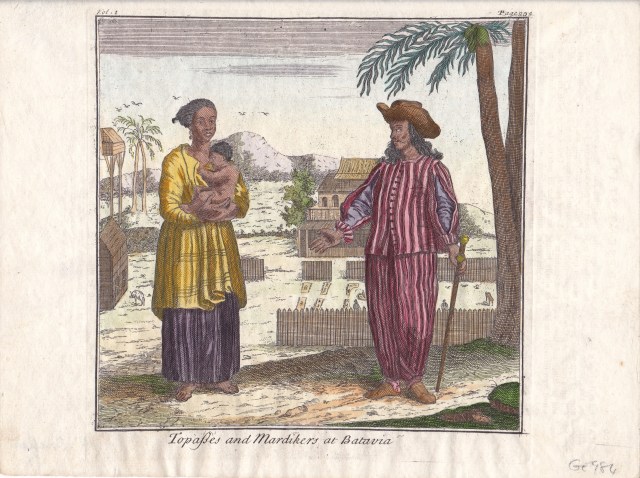
A Mardijker couple, presumably on the land granted to them outside Batavia in 1661, with possibly their original church in the background
The Mardijkers were granted land at Kampong Tugu (Toegoe) which is now near the port area of Tanjung Priok. At that time 150 Mardijkers moved to this area and after three centuries there is still a community living there. They have retained their original identity over this time and their land contains their own church, graveyard, schools, community centre and cultural centre.
A search of the cemetery shows the family names of Michiels, Qiuko, Thomas, Corua and Abrahams are prominent. The most successful of the Mardijkers was Augustin Michiels who became commander of the indigenous militia and a wealthy landlord.
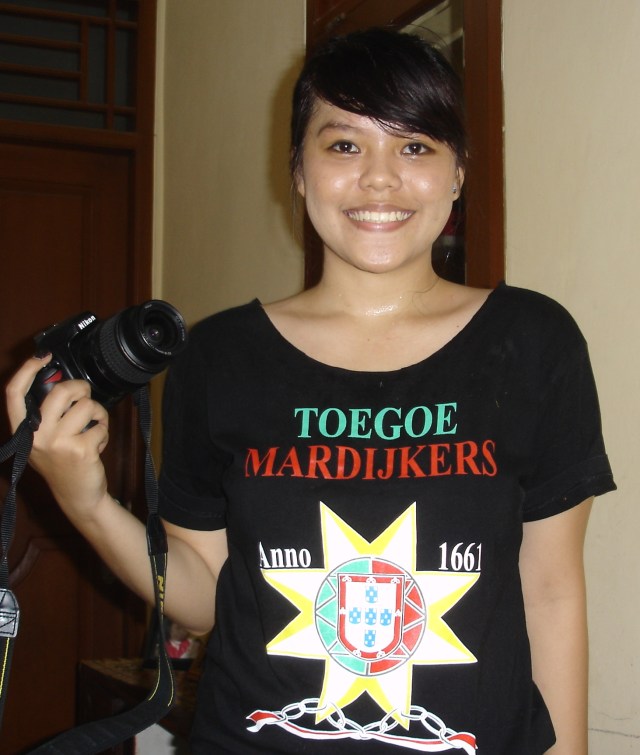
After 350 years the Mardijkers of Kampung Tugu are still proud of their identity and the photo shows one of the Michiels family wearing a T-shirt showing the Portuguese shield and the breaking of the chains of slavery in 1661.
A modern day Mardijker from Kampung Tugu
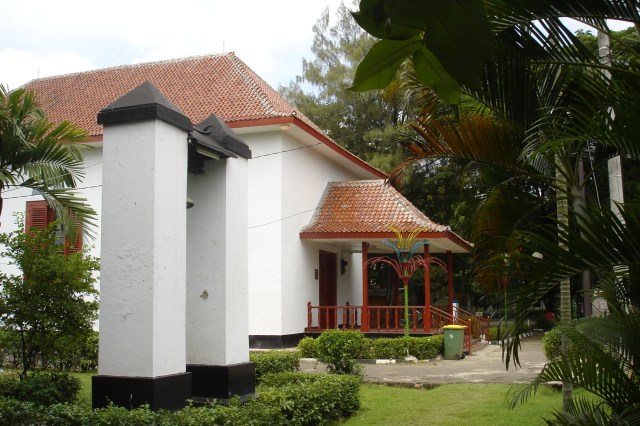
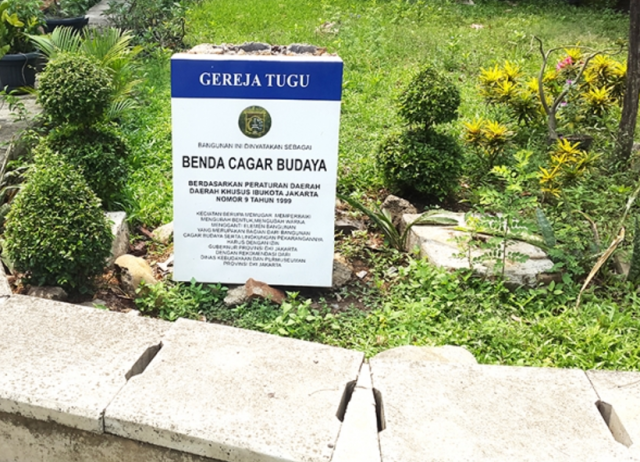
The original wooden church built in Kampong Tugu after 1661, burnt down and was rebuilt in stone, this was renovated in 2007 and is now designated as an historic landmark by the city of Jakarta.
The bell tower and entrance to the historic Tugu church
Gereja Tugu. A designated historic landmark by the City of Jakarta
The Mardijkers have kept their musical tradition alive until today through the small ukulele style instrument known as the keroncong. It is this instrument that has given its name to their music which is derived from old Portuguese folk songs influenced by the music of North Africa and known as Portuguese Mouresco. Originally played by street musicians the music gained wider acceptance during the Dutch colonial period when it was played together with a violin, guitar, bass, tambourine and flute. It evolved to include Dutch and Indonesian songs and the Krontjong Toegoe band has performed in Holland where the song ‘Oud Batavia’ brings tears of nostalgia to a generation of Hollanders who still remember the old times or the ‘tempo doeloe’ in Indonesia.
The Krontjong Toegoe band preparing to play ‘Oud Batavia’
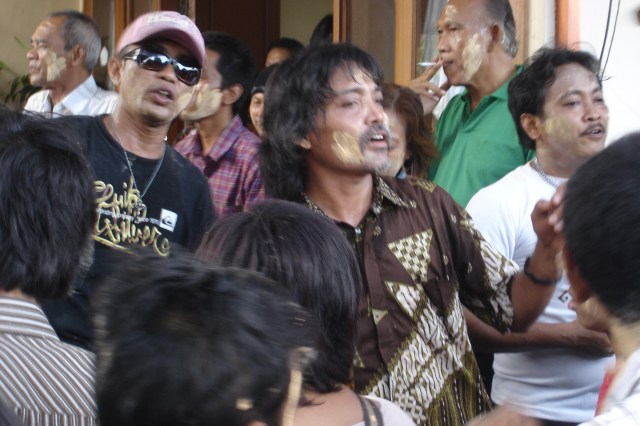
The Mardijkers celebrate the New Year with great gusto in an event called Mande-Mande, whose origins probably belong in India or Sri Lanka, which includes the custom of smearing each others faces with a mixture of water and face powder.
Here Andre Michiels celebrates Mande-Mande with other members of the Mardijker community in Kampung Tugu
What Burnet achieves in his wonderfully illustrated and narrated book is to relate the important role the Indonesian archipelago has played in the intellectual history of the West. In their separate voyages Banks, Darwin and Wallace discovered the astounding diversity of the southern hemisphere’s natural world, and it was through their observations that the enlightenment truly came of age. Western thought found it could not reconcile the static divine word of the Bible with the diverse and ever-evolving scientific reality of the natural world.
… Ian Burnet’s very perceptive use of quotes from their public writings and private diaries allow us to see through their eyes the world they found and understand the intellectual problems it raised for them.
… Like the geology of the earth we live on, and like British society that founded modern Australia this wonderfully enlightening and delightful book is many layered
— The Indonesia Institute, Dr. Ron Witton
I would like to thank Ian Burnet for writing ‘Where Australia Collides with Asia’. In his book he explains the significance of the work of these great scientists and states clearly the key place that our Asian neighbourhood has played in their ideas. It brings to life not just Darwin and Wallace but others such as Joseph Banks, Captain James Cook, Captain Robert FitzRoy of the Beagle and many others. Written in an easy to read style, with many illustrations, we are introduced to these individuals as real people and the personalities behind their famous names …
The decades Ian has spent living and travelling in Indonesia and his training as a geologist, have contributed many wonderful layers to this book. The fact that the first of the voyages he writes about is the voyage of the tectonic plates – the voyage of continent Australia – is a wonderful way to start his narrative as it ideally provides background to what is to come.
I commend this book – you will be drawn into another world – a world that has a deep effect on the way we see ourselves and life around us today.
— Asia Bookroom, Sally Burdon
These voyagers are the three brilliant English naturalists who take the empirical natural sciences from their infancy to an epiphany in a bit less than a century. The first is the wealthy young Banks who self funds himself onto James Cook’s circumnavigation, England’s first great voyage of deliberate scientific discovery. En route, Banks and his entourage are the first to scientifically record Australia’s utterly unique flora.
Darwin is even younger when good luck puts him on HMS Beagle for its five-year charting voyage. This exposes him to South American fossils, Galapagos Islands finches and New South Wales platypuses. Back home, Darwin incubates the idea of natural selection, but nervous about dethroning the stern Victorian Lord God of Creation, makes no anouncement.
Wallace is a self-educated working man who sells rare beetles, bird and animal skins for a living. He journeys across the East Indies travelling on mail boats, sailing ships, early steamers, schooners, native prahus and dugout canoes. In a malarial fever-dream he hits upon the idea of natural selection, synthesising all that he has observed in his many years of tropical travels, his letter from Ternate forces Darwin to finally get his masterpiece ‘On the Origin of Species’ into print.
Ian Burnet reminds us that Alfred Russel Wallace is not only the independent co-discoverer of evolution but also a founder of the science of bio-geography as in the discovery of the Wallace Line which separates the species of Asia from Australasia. He has applied his customary skills, in taking the vast bibliographies that document the lives and voyages of the three English naturalists and turning them into an easy and engaging read.
— Jeffrey Mellefont, Research Associate, Australian National Maritime Museum
On the 17th of August 1945, 72 years ago, Dr Ir Soekarno and Mohammad Hatta proclaimed Indonesian independence from the Netherlands and the following day were appointed as the first President and Vice-President of the newly declared Indonesian Nation.
Hatta and Soekarno preparing a proclamation document
At 10am on the morning of 17 August 1945, Soekarno stepped out onto the porch of his residence to read out the Proclamation of Independence, flanked by Hatta and a Japanese liason officer.
Brothers and Sisters All!
I have asked you to be in attendance here in order to witness, an event in our history, of the utmost importance.
For decades we, the People of Indonesia, have struggled for the freedom of our country- even for hundreds of years!
There have been waves in our actions to win independence, which rose, and there has been those that fell, but our spirit still was set in the directions of our ideals.
Also during the Japanese period, our efforts to achieve national independence never ceased. In this Japanese period it merely appeared, that we leant upon them. But fundamentally, we still continued to build up our own powers, we still believed in our own strengths.
Now has come the moment, when truly, we take the fate of our own actions and the fate of our own country into our own hands. Only a nation bold enough to take its fate into its own hands, will be able to stand in strength.
Therefore last night, we had deliberations with prominent Indonesians from all over Indonesia. That deliberative gathering was unanimously of the opinion that NOW has come the time to declare our independence.
Brothers and Sisters:
Herewith we declare the solidarity of that determination.
Listen to our proclamation:
Soekarno making the Proclamation of Independence with Hatta standing on the right and a Japanese liason officer on the left
The Proclamation of Independence went through many complicated draft versions but finally very simply read:
PROCLAMATION
We the people of Indonesia hereby declare the independence of Indonesia.
Matters which concern the transfer of power and other things will be executed by careful means and in the shortest possible time.
Djakarta, 17 August 1945
In the name of the people of Indonesia
Soekarno/Hatta
We are now already free!
There is not another single tie binding our country and people!
As from this moment, we build our state. A free state, the State of the Republic of Indonesia – evermore and eternally independent. Allah willing, God blesses and makes safe this independence of ours!
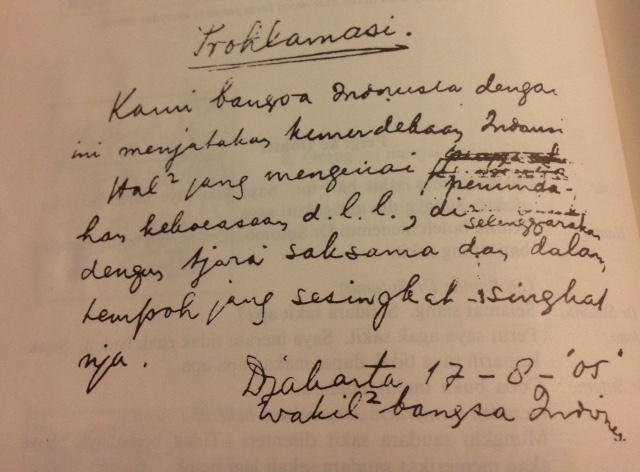
The original handwritten proclamation document. The ’05’ refers to 1945 or 2605 in the Japanese calendar
The Proclamation of Independence document
Saudara- suadara sekalian
Saya telah minta saudara-saudara hadir disini, untuk menyaksikan satu peristiwa mahapenting dalam sejarah kita.
Berpuluh- puluhan tahun kita bangsa Indonesia telah berjoang untuk kemerdekaan tanah air kita – bahkan telah berates- ratus tahun!
Gelombang aksi kita untuk mencapai kemerdekaan kita itu ada naiknya, dan ada turunnya, tetapi jiwa kita tetap menuju ke arah cita-cita.
Juga didalam zaman Jepang, usaha kita untuk mencapai kemerdekaan nasional tidak berhenti-berhentinya . Didalam zaman Jepang ini tampaknya, bahwa kita menyandarkan diri kepada mereka. Tetapi hak ekatnya, tetapi kita menyusun tenaga sendiri, tetapi kita percaya pada kekuatan kami sendiri.
Sekarang tibalah saatnya kita benar-benar mengambil sikap nasib bangsa, dan nasib tanah air kita, didalam tangan kita sendiri. Hanya bangsa yang berani untuk mengambil nasib dalam tangan sendiri akan dapat berdiri dengan kuatnya.
Maka kami tadi malam telah mengadakan musyawarat dengan pemuka-pemuka rakyat Indonesia dari seluruh Indonesia. Permusyawaratan itu seIa sekata berpendapat bahwa sekaranglah datang saatnya untuk MENYATAKAN KEMERDEKAAN KITA!
Saudara – Saudara sekalian!
Dengan ini kami menyatakan kebulatan tekad itu. Dengarkanlah Proklamasi kami
PROKLAMASI
Kami, bangsa Indonesia, dengan ini menyatakan kemerdekaan Indonesia.
Hal-hal jang menenai pemindahan kekoeasaan d.l.l., diselenggarakan dengan tjara saksama dan dalam tempo jang sesingkat-singkatnja.
Djakarta, hari 17 boelan 8, tahoen 45
Atas nama bangsa Indonesia
Soekarno/Hatta
Demikianlah saudara-saudara kita sekarang telah merdeka! Tidak ada suatu ikatan lagi yang mengikuti tanah air kita dan bangsa kita! Mulai saat ini kita menyusun negara kita! Negara merdeka! Negara Republik Indonesia! Merdeka kekal abadi! Insya Allah Tuhan memberkati kemerdekaan kita ini.
Thanks to Anthony Liem for providing the full text and translation.
Thanks to Toni Pollard for providing the handwritten proclamation
The printed copies of Where Australia Collides with Asia have finally arrived and there is nothing more exciting than holding the final result of many years of work in your hand. Unfortunately this feeling of euphoria is usually followed by the nagging thought as to whether it is any good. However, as always, it is the discerning reader who will decide.
Where Australia Collides with Asia follows the epic voyages of natural history of Continent Australia, Joseph Banks, Charles Darwin and Alfred Russel Wallace.
The voyage of Continent Australia after it breaks away from Antarctica 50 million years ago with its raft of Gondwanaland flora and fauna and begins its journey north towards the equator.
The voyage of Joseph Banks on the Endeavour who with Daniel Solander became the first trained naturalists to describe the unique flora and fauna of Continent Australia that had evolved during its 30 million years of isolation.
The voyage of Charles Darwin on the Beagle, who after his observations in South America and the Galapagos Islands, sat on the banks of the Coxs River in New South Wales and tried to rationalize his belief in the idea of biblical creation and understand the origin of species.
The voyage of Alfred Russel Wallace, who realized that the Lombok Strait in Indonesia represents the biogeographical boundary between the fauna of Asia and those of Australasia. On the Asian side are elephants, tigers, primates and specific birds. On the Australasian side are marsupials such as the possum-like cuscus and the Aru wallaby, as well as birds specific to Australia such as white cockatoos, brush turkeys and the spectacular Birds of Paradise.
It was tectonic plate movement that brought these disparate worlds together and it was Alfred Russel Wallace’s ‘Letter from Ternate’ that forced Charles Darwin to finally publish his landmark work ‘On the Origin of Species’.
Available on order from your favorite bookshop or online retailer for A$34.95
What Burnet achieves in his wonderfully illustrated and narrated book is to relate the important role the Indonesian archipelago has played in the intellectual history of the West. In their seperate voyages Banks, Darwin and Wallace discovered the astounding diversity of the southern hemisphere’s natural world, and it was through their observations that the enlightenment truly came of age. Western thought found it could not reconcile the static divine word of the Bible with the diverse and ever-evolving scientific reality of the natural world.
… Ian Burnet’s very perceptive use of quotes from their public writings and private diaries allow us to see through their eyes the world they found and understand the intellectual problems it raised for them. Moreover in the case of Darwin and Wallace, we enter into their very troubled worlds as they tried to explain the diversity of life they found.
… Like the geology of the earth we live on, and like British society that founded modern Australia this wonderfully enlightening and delightful book is many layered
— The Indonesia Institute, Dr. Ron Witton
Where Australia Collides with Asia will be launched at the Canberra Writers Festival on Saturday August 26 at 2pm at the National Library of Australia, when Ian Burnet will be in conversation with Sally Burdon of the Asia Bookroom (a free event).
Today, July 31, 2017, is the 350 year anniversary of the signing of the Treaty of Breda which ended the second Anglo-Dutch war. Included in the Treaty was an agreement to exchange the Dutch claim to the island of Manhattan for the English claim to the island of Run which is now part of Indonesia.
The following is an article by Jewel Topsfield, the Indonesia correspondent for Fairfax Media, published in the Sydney Morning Herald and the Melbourne Age.
Even old New York was once New Amsterdam
Why they changed it I can’t say
People just liked it better that way Istanbul (Not Constantinople), 1953
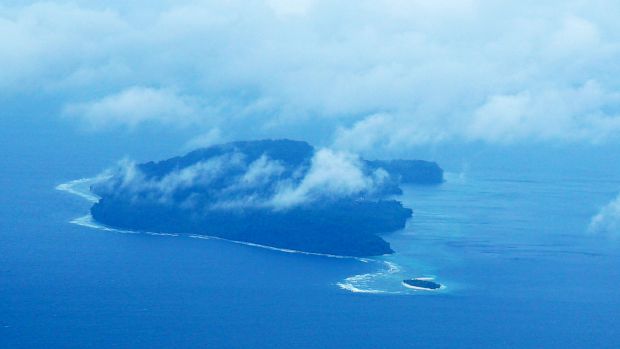
Run, a tiny island in Indonesia, is about three kilometres long and one kilometre wide. Photo: Jefri Tarigan
Not many will have heard of the object of their feud – Run – a coconut-fringed island about three kilometres long and one kilometre wide. But everyone knows the island for which Run was eventually swapped.
On July 31, 1667 the Dutch and the English signed the Treaty of Breda. As part of the agreement, the swampy island of Manhattan in New Amsterdam – which the Dutch had “bought” from the Native Americans – was exchanged for the island of Run.
The island was famed for its nutmeg which is still farmed by locals. Photo: Jefri Tarigan
Ian Burnet, the author of East Indies, describes it as “the real estate deal of the millennium”.
At the time the Dutch were adamant they were the victors. “Few would have believed a small trading village on the island of Manhattan was destined to become the modern metropolis of New York,” writes Burnet.
Historian John Keay believes Run is to British imperial history what Runnymede, where King John signed the Magna Carta, is to British constitutional history.
Today Run has a population of about 2050 and is desperate for infrastructure. Photo: Jefri Tarigan
“Every overseas empire had to begin somewhere,” he wrote in The Honourable Company. “There might, for instance, be a case for locating the genesis of the British Empire in the West Indies, Virginia or New England. But there is a less obvious and much stronger candidate. The seed from which grew the most extensive empire the world has ever seen was sown on Pulo [island] Run in the Banda Islands at the eastern end of the Indonesian archipelago.”
A farmer harvests nutmeg on the tiny island of Run. Photo: Jefri Tarigan
In 2017, Run is almost as inaccessible and isolated as it was 350 years ago. The trip is still epic. Theoretically a Cessna Grand Caravan flies twice a week from Ambon to Banda Neira, an island near Run. But a plane part is missing that has to be sourced from Jakarta, or Papua, or the United States.
When Fairfax Media photographer Jefri Tarigan finally catches the ferry, an expected 12-hour voyage blows out to 17 hours in the monsoonal swell. Run is another two-hour boat trip from Banda Neira.
Dried nutmeg in Run. Most islanders still farm nutmeg and cloves as well as fish for tuna. Photo: Jefri Tarigan
The fragrant reason for Run’s fame – the tropical tree Myristica fragrans – is still ubiquitous on the island. Its seed is the source of nutmeg; its aril, or seed covering, the source of mace.
The islanders sprinkle nutmeg in their coffee and make candied sweets, soup and a treacly jam from the fruit. They export the flower, used to make cosmetics for Europeans and to preserve corpses.
But the golden era, when nutmeg was worth more than gold, is long over. Up until the 19th century, the Banda (or Spice) Islands were the only place in the world that Myristica fragrans flourished. The coveted Run – one of the 11 small volcanic islands – must have seemed like heaven.
“What we need most is electricity and health practitioners”, Says Burhan Lohor. Photo: Jefri Tarigan
There is little the salt-and-pepper-haired civil servant Burhan Lohor doesn’t know about the history of Run, so named, he says, because the English ran here from Banda Neira to escape the Dutch.
“There was nothing in New Amsterdam, nothing to be proud about, it was an uninhabited island. Banda was famous among European nations.”
The first Britons to visit Run, in 1603, would “willingly have sailed around the world several times” for nutmeg, writes Keay in The Honourable Company.
It could be bought for a pittance in the Banda Islands but when sold in Europe its value went up about 32,000 per cent.
English East India Company officer Nathaniel Courthope took possession of the island in 1616 when the islanders signed a contract accepting King James I of England as their sovereign.
“Not without pride would James I come to be styled ‘King of England, Scotland, Ireland, France, Puloway (Pulo Ai) and Puloroon (Pulo Run). The last named, thought one of its visitors, could be as valuable to His Majesty as Scotland,” writes Keay.
The Breda Treaty ended the Second Anglo-Dutch war. The British relinquishment of Run gave the Dutch control over the Banda Islands and a global spice monopoly.
“It is important to know this event in history because it demonstrates how colonialism was carried out by Western nations in the New World,” says Indonesian historian Bonnie Triyana. “England, the Netherlands, the Portuguese and Spain were in competition to find new colonies driven by their desire for wealth. They arbitrarily treated what they found as mere commodities. These processes in history shape our situation today.”
Over the next 70-odd years the Dutch East India Company would become the most powerful trading company the world had ever seen.
But East Indies author Burnet says over time the prices fetched for spices – once the ultimate prestige item in Europe – began to decline. “The advent of tobacco, tea, coffee and other stimulants reduced the social status of spices,” he says.
When the British recaptured the Banda Islands during the Napoleonic wars they transplanted nutmeg seedlings to places such as Bengkulu in Sumatra and Penang. The price of nutmeg in Run plummeted and the Banda Islands ceased to be of much value to the Dutch.
And as for Manhattan? Well the rest, as they say, is history.
Today Run has a population of about 2050. Most islanders still farm nutmeg and cloves as well as fish for tuna. After the colonial era nutmeg farms were owned by the government. In 1982 the locals took over a state-owned enterprise called Praja Karya and distributed nutmeg trees equally among all the families on the island.
But the island is desperate for infrastructure: “What we need the most is electricity and health practitioners,” Burhan says.
Run has one medical clinic with no doctor and insufficient medicine: “People complain that every time they are sick and go to the clinic they are always given three pills – the yellow one, the blue one and the white one.”
A doctor is an often treacherous 2½-hour boat trip away in Banda Neira – too far for an emergency caesarean or heart attack.
Burhan says islanders turn to traditional medicine, using leaves, roots from their garden and herbs. Toothache is treated with the sap from a tree known locally as Akar Olaola. “God willing, the pain will be gone.”
Electricity is only available between 6pm and 11.30pm, none of it provided by the government. Three years ago a Run native – now a successful Jakartan businessman – provided a diesel generator to supply the homes for five hours every night.
“After that you sleep in the dark all night long on Run Island,” Burhan says. “So if you come from Manhattan to Run you’ll see a huge difference.”
Some tourists do come to Run despite the isolation – mostly westerners and journalists. One famous visitor was Indonesian artistic director Jay Subyakto, who was making the documentary Banda, The Dark Forgotten Trail, which is partially filmed on Run.
“It is very ironic. Run Island does not exist on the map,” Subyakto says. “People hardly know where it is and Run Island is now neglected.”
When Subyakto tells people about the first genocide in Banda Neira their eyes glaze over. But they boggle when he tells them Run was swapped for Manhattan.
“Why do we always marvel about anything to do with the West? In the context of Run Island, they should be ashamed they don’t know history.”
Subyakto says Indonesia has been blessed with natural resources such as nutmeg, cloves, oil, gold, coal and palm oil that is sought after by other countries. “But in the end we were colonised or cheated by trade contracts and politics. Until today, our people never enjoy the blessings of our rich natural resources. I think we never learn from history and therefore we made Banda, The Dark Forgotten Trail.”
The documentary will premiere on July 31, to coincide with the 350th anniversary of the signing of the Treaty of Breda.
But the Run islanders who appear in the film won’t be able to watch it on the island. There is no movie theatre in Run nor is there Wi-Fi. “Even our phone connection is bad, let alone internet connection,” Burhan says.
“Honestly, there is a feeling of pride that our island was chosen to be exchanged with another place. However, there is also regret that years after the exchange took place there is a huge difference between Run and New Amsterdam today. It’s like heaven and earth … but now the situation is in reverse”.